ANXIETY, BURNOUT & HOW TO LOVE YOUR LIFE AGAIN | Elke Scholz | W.A.R. Network
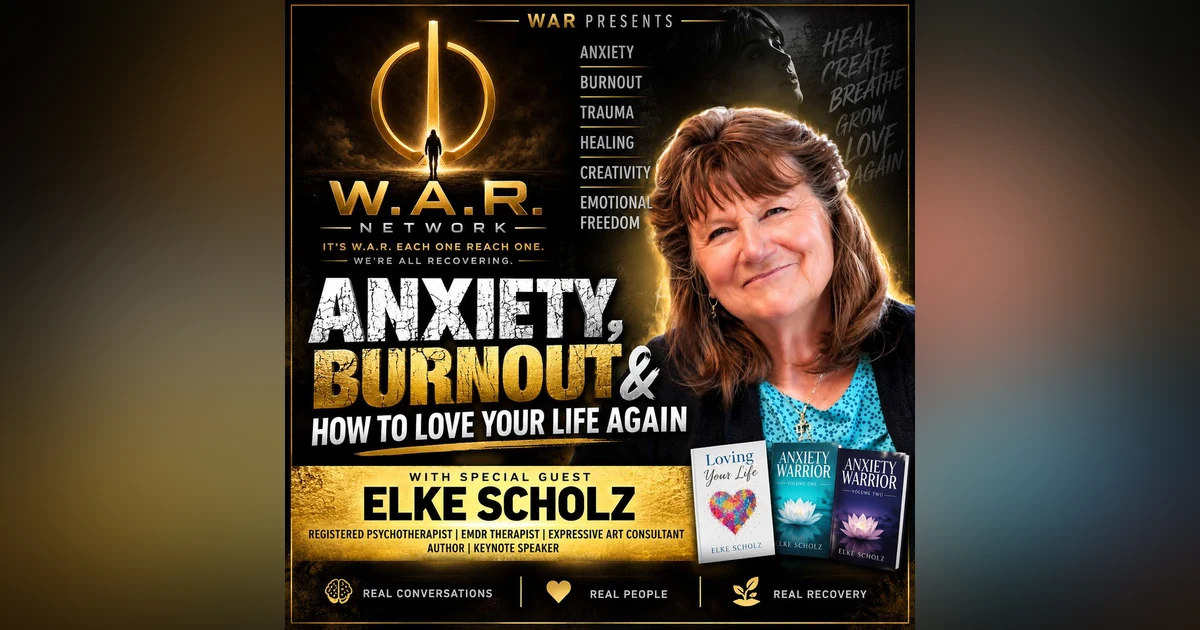

Join W.A.R. Founding Members What happens when you’re still functioning on the outside, but anxiety, burnout, and emotional exhaustion are quietly taking over your life? On this episode of W.A.R. Network, Stryker sits down with registered psychotherapist, internationally certified EMDR therapist, expressive art consultant and educator, keynote speaker, and author Elke Scholz for a powerful conversation about anxiety, trauma, burnout, creativity, energy, and learning how to love your life ag...
What happens when you’re still functioning on the outside, but anxiety, burnout, and emotional exhaustion are quietly taking over your life?
On this episode of W.A.R. Network, Stryker sits down with registered psychotherapist, internationally certified EMDR therapist, expressive art consultant and educator, keynote speaker, and author Elke Scholz for a powerful conversation about anxiety, trauma, burnout, creativity, energy, and learning how to love your life again.
With more than 35 years of experience helping people navigate anxiety, panic, depression, burnout, and emotional exhaustion, Elke brings both professional expertise and personal understanding to the conversation. She openly manages her own anxiety and calls herself an “Anxiety Warrior,” making this discussion about more than theory. It’s about living through it.
Stryker and Elke dive into what anxiety actually feels like, why being functional doesn’t necessarily mean you’re okay, the difference between being tired and truly burned out, and the hidden habits, relationships, thoughts, and pressures that can quietly drain your energy.
They also explore trauma and EMDR, how unresolved experiences can continue affecting the mind and body, why highly functioning people can still struggle beneath the surface, and how creativity can become a powerful tool for expression and healing.
Elke also shares insight from her book Loving Your Life and discusses practical ways people can begin listening to themselves, protecting their energy, setting healthier boundaries, reconnecting with passion, and moving from simply surviving life toward actually experiencing it.
In this conversation:
• Understanding anxiety beyond panic attacks
• The warning signs of emotional burnout
• Why functioning is not the same as healing
• Trauma, the nervous system, and EMDR
• Becoming “energy rich” instead of emotionally drained
• Creativity and expressive arts as healing tools
• Fear versus intuition
• Boundaries and protecting your mental health
• Learning how to listen to yourself
• Practical strategies for calming anxiety
• What it really means to become an Anxiety Warrior
• How to start loving your life again
If you’ve been exhausted, overwhelmed, anxious, emotionally drained, or simply wondering when life stopped feeling like something you actually enjoy, this conversation is for you.
Share this episode with somebody who needs to hear it.
IT’S W.A.R. We’re All Recovering.
Each One Reach One.
#Anxiety #Burnout #MentalHealth #TraumaHealing #WARNetwork
Welcome home. Welcome back to war. We're all recovering. Today we're talking anxiety, burnout, emotional exhaustion, creativity, trauma, and how people can start loving their life again instead of just surviving it. Our guest tonight is Elka Schultz. Elka is registered psychotherapist, internationally registered expressive art consultant, and educator, internationally certified EMDR therapist, keynote speaker, and author of Loving Your Life, along with Anxiety Warrior Volume 1 and 2. So check that out. For over 35 years, she has helped people manage anxiety, panic, depression, burnout, and emotional exhaustion. She also manages her own anxiety, which makes this conversation real, human, and powerful. Elka, welcome to war. It's a pleasure and it's an honor to have you.
SPEAKER_02Thank you. Honor to be here. Thank you.
SPEAKER_01Yes, ma'am. Elka, before we get into anxiety, burnout, and emotional freedom, I want people to know who you are. How would you introduce yourself to someone who has never heard your story before?
SPEAKER_02Wow, good question. I am passionate about helping people and easing their journey. I think there's an easier way. So I would describe myself as very practical. My gift is to capture things that are very accessible, like easy to do. So it's something that you can do right now. So your audience can do things right now. They don't have to buy something. They don't, they can just learn it and share it. So that would that would be who I am. It's my passion.
SPEAKER_01I love that. I love that because you have a lot of titles, and I love that too. And titles are great, but people connect with the human being behind the title. And that's what this show's about. Real people, real battles, and real recovery. So I love that. Thank you for that.
SPEAKER_02One of the things that I say to my clients, and you know, I say, just because I'm sitting in this chair does not mean that I have a down pat. I'm still, and I use I use the strategies I share, and I'm I'm honest about it. I mean, it's the client's session for sure. However, you know, I do share and say, you know, life is practice.
SPEAKER_01Definitely. Oh, definitely. Well said. Yeah. You've been doing this work for over 35 years.
SPEAKER_02Yes, I have.
SPEAKER_01That's that's wow.
SPEAKER_02I I started when I was five.
SPEAKER_01Wow. Okay, you gotta tell us more about that. Okay. So what pulled you into helping people with anxiety, creativity, wellness, and emotional healing?
SPEAKER_02I think it started in my 20s because, and and bless my father, um, he being a very practical German high school teacher, um did not believe in the arts. He he was all about math and history and and practical um strip you know, practical tools. So I did not fit into that. My b one of my brothers is a was is a retired football player as well as an engineer. My other brother uh helped professors and designed uh growing uh experiments in and he ran the greenhouses for Guelph University. And then there was me that just didn't fit in. Um I worked so hard in school. I felt actually there was times I didn't want to live. And uh two teachers, and one in particular I attribute to uh changing my worldview and uh my life. And and uh we've had I've had the privilege to be able to tell them that. So that's how that started. And so I I was constantly feeling weird, um, this square pig, you know, that didn't fit in a round hole kind of thing. And and uh yet I still beat him my own drummer. And when I discovered the arts, I discovered it through calligraphy, and it just changed my world. I just felt that, oh my gosh, I found something that um I could thrive at, and and I was obsessed with it. And I'm also obsessed with writing it, though I didn't realize that until after I wrote my book, that I'm a writer. I write every single day. I've been writing actually since I was about five.
SPEAKER_01Wow.
SPEAKER_02I've got poems and things I wrote, and um one of those teachers, uh, she helped us uh uh honor all our our writings. So we had pasted them all in a book, all these little pieces of paper, and the other teacher was a drama teacher.
SPEAKER_01Wow, that's it sounds like you were born with this, you know, just born with this gift, you know, and your life was already mapped out for you. You know?
SPEAKER_00Yep.
SPEAKER_01And it's powerful, you know, because when somebody dedicates, you know, decades of their life to helping people heal, that usually comes from somewhere deep. You know, and it sounds like it.
SPEAKER_02Yeah, and when I say I started when I was five, maybe I was I could have been maybe a bit younger, but I remember I remember looking over a dresser drawer. So, you know, your nose is up to here. Right. It's a dresser, and there was a mirror, and I and I remember looking in my eyes, and I felt ancient. And it was different than you know, we always think our parents are old when we're that little.
SPEAKER_01Right, right.
SPEAKER_02Um, however, I felt really ancient. I knew I was old, like really old. And I also was one of those kids that asked questions that the adults couldn't answer or didn't want to, or said, we'll tell you later, or we'll get back to you.
SPEAKER_01Okay. Okay, okay. Like get out of here.
SPEAKER_02Well, they most of the time they were kinder, but they they certainly scratched their heads because that's how I I was thinking. And so it did start very early on, and and there was this uh struggle of this knowing and and then you know really not knowing and feeling um very uh inept. My brothers uh did very well in school. I struggled in school, and I I thought this is it interesting, I thought I was not university material. And no one told me that. That was something I struggled with. And um I don't know what system you guys had, but we had the four-year system and the five-year in school.
SPEAKER_01Uh sometimes they call it the science um road or the the um, you know, the um for the university or before the four years.
SPEAKER_02Yeah, and I was more on the applied, and that was not good for the high school teacher's daughter. She was supposed to be university material, and she was she didn't feel she was. And I I was this kid that excelled at drama, uh, four-year programs like conversational Spanish, uh, poetry, writing, creative writing. And uh I wanted music in the arts, but that wasn't in my dad's wheelhouse.
SPEAKER_01Oh wow. Oh wow. Well, you found your calling, definitely, it sounds like.
SPEAKER_00Yeah.
SPEAKER_01And so I think that's awesome. I like I said, I think it was your life was mapped out. You know, as soon as you looked over that dresser and looked into the mirror, it was like it was it was there already, you know?
SPEAKER_02Yeah, yeah. I've written in a short story about that, which um might soon be ready to be published. However, what you know, when you said how did this come about, then what what I what I got from that drama teacher, and I didn't realize that till I started teaching courses. And he would come in the classroom, this was grade 11, he would come in the classroom, he'd look at us, and then he'd just say, you know, we're gonna do something different today. And he really went with what we were bringing to the class. And I remember I didn't want to uh participate, I didn't raise my hand or anything like that at the beginning. And uh by the end of the year, I was doing a soliloquy on stage by myself. And I um and I didn't, it's interesting because I, you know, at the time you're just a kid, you're 16, and you don't see it as extraordinary. And uh I did write him a letter, and you know what, James, he kept that letter, and um he actually never gave it up. He kept it on his desk, and and um he sent me a color photocopy of it because it meant so much to him. Right, right. And um yeah, and then what I realized as I started teaching classes, I was bringing into this intermodal, this expressive arts idea without having that language. And what I noticed is that my students all did super well. And so instead of thinking, oh, you know, is this a great teacher? I I kept thinking, what what is it that I'm doing that's helping them succeed? You know, what why? Because I was I'm always curious as to see, you know, what's helping people. So I'm a bit of a neuroscience geek.
unknownI'll throw that in.
SPEAKER_02So I'm always wondering, you know, what what makes um what makes it that people succeed? And and so I started collecting these ideas without understanding what um my teacher had had expressed to me. And his name is Bill Hodwitz, so I want to do a shout out for him.
SPEAKER_01Shout out to Bill Hodwit.
SPEAKER_02Yeah, Hodwits, yeah. And and so then as I um I lived in Toronto for a while, so not far from Scarborough. Yeah, and um I also did re my students did really, really well. And so I had this group of women that um they and this is in a very uh difficult area in Toronto, um lots of crime and upset. And um, however, for whatever reason, I mean, my students did really well, and even my little ones, um, and I have a fun story about that. So I worked with these women, they trusted me, and I said, let's let's do some experimenting because there's something here that we're doing that's working. And so we did that, and part of it was to slow down to meditate, and we invested that time in slowing down, and then it was also this um connection that we were we were having. Um, and they had the best days. They said the day we have with you, we have the best rest of the day, and usually the next day. And um, so that really got me on this path of what is going on with this intermodal work, with this work that um is helping people, like what are we doing?
SPEAKER_01I'm curious, how how many students about?
SPEAKER_02Uh well, that's a good question because oh, are you getting echoed?
SPEAKER_01Did I lose you?
SPEAKER_02No, no, no. So about six to eight, and that is actually a really good number. So it's very important because when we have these massive classrooms, we as one teacher cannot help and be connected with everybody. Right, right. Um when you have a small group, and then when I worked in this inner city recreation center, um, these kids they were wild. I mean, and and and they weren't-I never believed kids were bad. I always thought there's something they needed. And so when they came after school, I knew they were hungry because I was always hungry after school, and so were my brothers, they were famished. So I put out snacks and we sat in a circle, and they'd come in and we would just sit and I'd ask them about their day. And I didn't un I didn't know at the time the power of that connection for them. And and then they would say to me, they'd say, Miss, what do after after all the connections? And they told me wild stories. I mean, we're talking about drugs and shootings and um that they saw that day or that they experienced. And um, and uh so you just listen, you don't react, you just say, you know, just oh wow, tell me more about that. And you know, and then they when they were ready, they said, What are we doing today? Because I always had crafts for them. And and these kids, my supervisor, he called me in and he said, Um, what are you doing to the kids? I said, What do you mean? I said, My door is open. My door is open, my door is open. Come on in and join us. He goes, No, no, no. And I said, Why am I in trouble? And he said, No. He said, Ever since you've been here, nothing is getting destroyed. And I went, What? He goes, Oh yeah, they used to tear railings down, break windows, paint the walls. He said, Since you've been here, we've had no no vandalism. And I just went, wow. And and it was just, it's the connection, right?
SPEAKER_01Right, right.
SPEAKER_02And so I I keep building on that. And for those kids, what I I asked them, I said, so you know, when do you get supper and when when are your parents home? It wasn't till seven or eight o'clock at night. So those kids were on the street from after school, 3:30, till seven or eight o'clock.
SPEAKER_01I know it, I know the feeling. I I've I've lived some of that myself. But Elka, I have to uh hit back on one comment. Yes. Uh I believe, and it's just me, that some kids are bad. And uh uh do you still feel that way that uh kids aren't uh bad? And how old were these were these kids, by the way?
SPEAKER_02Oh, they were little. Uh they were maybe seven to ten. And and I I actually the question that you asked is kids aren't bad.
unknownShh.
SPEAKER_01They good. Come on.
SPEAKER_02They're born were born perfect. Yeah. And then we also had another counselor, so he also was doing the older kids, like the teenagers. And so these kids aren't bad, but you raise a very, very good question. I work up north in Kacheshuan. It's a fly-in First Nations community. And I did a PD day for the teachers and the TAs and the staff, and I talked about trauma. And so these kids aren't bad. They're traumatized.
SPEAKER_01Right, right.
SPEAKER_02So they're dysregulated. So we did a I did a PA day, like an education day for the teachers on, you know, what does trauma look like? What happens to the brain? Um, why, why are these behaviors coming out? Like, and so give it. And they were like, it was amazing. They they were so involved, engaged, and they didn't realize. And then the vice principal, actually, no, the principal, she said to me, she goes, Why is it they don't leave the school? Why do they hang around all the time? And I said, Well, they're safe here. They're not getting hit, they're not getting things thrown at them.
SPEAKER_01Right.
SPEAKER_02Nobody's swearing at them. And she went, Oh, you know what? I thought that that they wanted to stay because they wanted to be here. And I said, Absolutely. They want to stay as long as they can.
SPEAKER_01Right, right, right.
SPEAKER_02Because it's safe.
SPEAKER_01Right.
SPEAKER_02And um, so that was a big eye opener. So yes, kids aren't bad.
SPEAKER_01Okay, okay. Just traumatized.
SPEAKER_02Yeah, and they're hurt.
SPEAKER_01Right, right. Yeah. Right. I can see that.
SPEAKER_02Yeah.
SPEAKER_01And you and you call yourself an anxiety warrior. You know that?
SPEAKER_00Yes, I do.
SPEAKER_01Yes, that phrase alone, you know, it feels strong. So what does being anxiety an anxiety warrior mean to you?
SPEAKER_02Yeah, thank you. I when I was titling the books, it didn't it didn't feel right to call it anti-anxiety, because anxiety is a human condition. And we need anxiety. It's useful. So I wanted to think of something that felt um like like we're fighting it, however, we're also mastering it. So the warrior is not um a fighter in the sense of uh fighting or or hurting, it's a sense of overcoming and managing. And so the poses on the books, um, I have them here, are actually yoga poses. And it's is the warrior pose. Whoops, let me see. There we go.
SPEAKER_01There we go. There we go, that's so beautiful.
SPEAKER_02It's a warrior pose, and I put the wing on it because again, it it isn't aggressive, and it's just as intense, I think, as a fight might be. Right. Right. However, it's it's how do you manage it? And it it's it's really incredible, actually, because I still get hit sometimes with um intense anxiety, and it's I just want to crawl under the covers and and and not go into the world.
SPEAKER_01And I love that title too, uh, because it doesn't sound like someone pretending anxiety disappears, you know, like you were saying. Sounds like someone who knows anxiety may show up, but it doesn't get to run the whole house, you know?
SPEAKER_02Right. Yeah. And and that's how I counsel my clients. They're one of the biggest worries is when we've had trauma or we have anxiety. And anxiety and depression go together, which is kind of crappy, but it they do. So if you have depression, you usually have anxiety, and vice versa.
SPEAKER_01Yes, yes, ma'am.
SPEAKER_02So my clients just are so afraid of going backwards. And it's not possible to go backwards. No. Because as soon as you've got a tool and you have some strategy, some awareness, you can't go back. So will it still happen? Yeah. And uh so it's not uh like a light switch where it doesn't work that way. So some some people feel discouraged. However, the encouraging part is that it's further apart and it's shorter.
SPEAKER_01Right.
unknownRight.
SPEAKER_02It doesn't come like a steamroller. Yeah. Oh yeah, sometimes it just hits you because life does that. And and when you're tired or hurt or worried, it's gonna get you.
SPEAKER_01I love that you said that because I was just telling a friend of mine why I say we're all recovering, because he says he's recovered. I said, until something triggers you, you know, you could be feeling great for for God knows how long, and something may just happen and trigger you. And then, you know, you're back to, you know, you know, feeling like you were before, and you like, damn, I thought I, you know, recovered. So that's why I say we're all recovering. And then he he finally understood what I was talking about, you know?
SPEAKER_02Yeah, and and yeah, my clients get worried. Sometimes they come back and they think, oh no, I've relapsed, and I go, you you didn't relapse.
SPEAKER_00Right.
SPEAKER_02Because you've come here and we're gonna just talk about our strategies. Exactly. It's not lasting for three weeks. Right. It was just a real bad morning or maybe a bad day, right? Or or moments. Like it it does get much, much shorter. Much shorter.
SPEAKER_01Yes, yes. I agree a hundred percent.
SPEAKER_02Yes. Well, we've lived it.
SPEAKER_01Right, exactly, exactly. I feel exactly what you're saying. And you all you also manage your own anxiety. Uh why was it important for you to share that openly instead Of hiding behind a professional title.
SPEAKER_02What I noticed, well, first, I didn't realize that I was suffering with anxiety. So the story, the narrative I had was I was hiding behind a mask. Because I was always this creativity facilitator, very positive, blah, blah, blah. And I was reading a book on anxiety and for somebody else. And I thought, well, I got to read up on this. And I was shocked because it seemed every page was about what I was going through. And I also had a moment where I had a couple car accidents very close together. And I wasn't sleeping for two years. I did not sleep. That is possible. And I went to my doctor and I said, I think I have anxiety. And she goes, Oh, I know you do. I've just been waiting for you.
SPEAKER_01Really? For two years?
SPEAKER_02That I couldn't sleep, but she was waiting for me to have have that admission. So that really started a big journey because as a kid, I stuttered. I had migraines. I had stomach aches. I I mean, I my dad, bless him, he thought I was faking it. My mom understood it. And here's the thing I didn't realize she had anxiety, not until a few years ago. And she shared that with one of my cousins. And I went, oh my gosh. So it was this unspoken um thing. I mean, I I I talk about it in my book, where you know, I would sometimes uh run into a field and just curl up in a fetal position till it left. And I felt like if anybody saw me, if I ever told anybody about it, I'd get locked up. And so so yeah, you didn't talk, I didn't talk about it. And then when I became, I still became a psychotherapist. I still, I still wrote a book because, and then what happened in my private practice, my clients would come in and it was like over and over again this anxiety, whether it was financial anxiety, whether it was connection, whether it was a diet or whatever was going on with them. And and I realized that we weren't talking about it. So I started doing talks at the schools, at church, at senior centers, and I just did it for free. I just because I thought we've got to talk about this. And and for me, it was a way of reaching out to 50 people or 100 people or 20 people, not just one person in my private practice. And then one day I came home and I went, and I and I'm always creating handouts. And I came home with these handouts in my hand, and I went, There's a book here. And I called my editor from my first book, and I said, Scott, I think I have another book. And he said, Okay, well, I'm going away. Send me what you've got, and I'll look at it when I get back. I sent him 63 pages. He said, How did you do that in such a short time? I said, This isn't a short time, this is years. Right. And um, so that's how the first anxiety warrior came about. And that was the other thing. Now there's more books. This book, what we really focused on was giving people strategies, and that was what was coming out in the talks is they wanted practical strategies, things they could do to calm this anxiety.
SPEAKER_01You know, that matters because you know, people are tired of fake perfection. I know I am. You know, sometimes hearing I struggle to give someone permission to stop feeling broken, you know?
SPEAKER_02Right. And and and stop it. And we're not really broken. We might be hurt, but we're not broken. Exactly. And and I um I created an event, a community event around Anxiety Warrior, and I did public speaking, and and I said, you know, I may still stutter, I might still switch my words. However, I'm so passionate about this. And people would come up to me and said, you know, if you can do this, then I can do it too. And I went, 100%. And so the second volume, the reason it came about was I I invited people in my community to write stories about how they overcame this debilitating anxiety and how they managed. And um, each story has their different strategies that they used. I didn't ask them to do that, I did that after. And then there were other people that had um again resources. So there won't be a volume three, um, because there's literally hundreds of resources after every chapter. People, the um, so there's 26 authors in total, we put our resources in there because we're not cookie cutters, right? We're not not all the same.
SPEAKER_01So, Elka, let me ask you this. For someone listening who says, Let me see, I don't know if what I'm feeling is is anxiety. How would you describe anxiety in simple human terms?
SPEAKER_02Yeah. It and yes, I get asked that. So anxiety is really an unpleasant feeling. And it doesn't matter if we call it stress, if we call it anxiety, it doesn't matter. And when we unpack it, you know, we feel it differently. Some people feel butterflies, some people get hives, some people pick their whether they pick their hair or their nails or bite their nails. Some people eat, some people don't eat. So it's it's not about defining what it is, it's just when you're not feeling well, look at what's going on. And uh that's what I talk about in the book because it comes from different directions. This where is this coming from? Your body's giving you clues.
SPEAKER_01Right. Because it's not it doesn't always have to be dramatic, right? Like correct.
SPEAKER_00Yeah.
SPEAKER_01Sometimes it's just, you know, racing thoughts, you know, a tight chest. I'm speaking from for about me, you know. Yeah. But you know, sleepless nights, you know, the irritability or feeling that something is wrong, even when nothing happened, you know, it's not always, you know, dramatic. Right.
SPEAKER_02And dramatic would be some people get they get the feeling of a heart attack.
SPEAKER_01Right, right.
SPEAKER_02And of course, always go and have that checked out, though. And I've had that too, where I had my chest hurt so bad. Um, I've only had that once, but and then I've had other other little pains, but I usually get butterflies. Um, and I also get that that almost that whole body tension um that's very um hypersensitive and and uh impatient. So it comes so many different ways, and there's no judgment and and there's also no measuring stick. So I tell tell people is you know what anxiety is for you if if you we don't have to judge it as if it's small or big, or if mine's worse than yours, or or yours is worse than mine. If it feels bad, it feels bad. It doesn't feel good. And so there's lots of strategies, and that I believe in that, that there's an easier way, there's practical ways, and and and that was my mission too, is as I was discovering, and my clients helped me because we would I would make notes. I discovered 11 different ways that anxiety, why it shows up. And um, I haven't really added to that. And my clients have helped me, my talks, you know, then um people would say, Well, what about this? I go, Yeah. So yeah, they're pretty solid. And even in a talk, and we can talk about some of those, is people have said, Wow, just in knowing that has lowered my anxiety. It's manageable, it is manageable.
SPEAKER_01So with it's so many medical terms, like even I get confused sometimes. Or when I when I first started having these anxiety attacks and everything, I was just so confused because like some like I would talk to my friends before I sought, you know, medical you know, advice or anything like that. I would just tell my friends what's going on. They would say, Well, that sounds like a panic attack. Like, what's the difference between a panic attack and an anxiety attack?
SPEAKER_02I don't think there's a difference.
SPEAKER_01Is it the same thing?
SPEAKER_02Well, that's what I mean is why why do we have to give it a name? We can just say it's an attack. Like it's it's so here's the thing is when anxiety is so uncomfortable that it immobilizes us, or it's so painful or so debilitating that we can't move forward or do something, whether it's apply for that job, or whether it's leaving the house, or whether it's just, you know, trying to have a meal. I mean, that's when we want to really look at what's going on. And so that attack, you know, that that um whether we call it a panic attack or anxiety attack, it doesn't really matter. It means that it's just that debilitating.
SPEAKER_01Right. Like I was told, oh, a panic attack happened suddenly in uh uh like certain situations or in an anxiety attack is is something that built up gradually over time. And it kind of made sense to me, but it then it didn't make sense to me. It like if it's giving you the same feeling, it's just it's the same thing to me in my eyes.
SPEAKER_02Right. Yeah, so yeah, we don't, and I talk about that actually in the book is you know, we we want to give it names or we want to define it. And like worry is not anxiety, so worry is that negative thinking, right? And uh where it has elevated from concern. So it's like that repetitive, and it actually comes from an English uh root word to strangle. What? Yeah, so so rigone, rigon is uh that's where worry comes from. So worry is different than anxiety, and fear is different than anxiety. Right. So uh so it's those are really the differences, and and when we have panic attack, we can actually worry or have anxiety about having a panic attack. I mean it's or easy.
SPEAKER_00Yes.
SPEAKER_02Yeah, it's it's a thing. And and we can also say it differently, and I don't want to confuse listeners, but you can also have anxiety about having an anxiety attack. That's a thing. And because um, you know, we have I think still there's uh cultural shame around having these attacks.
SPEAKER_01The mind is a complex, just wonderful thing, but so mysterious how it works. And why do you think so many people minimize anxiety and tell themselves, oh, I'm fine? You know, when they're clearly not.
SPEAKER_02Well, we're in a culture, and I think North America, I'm not so sure about Europe. I don't spend a lot of time there. However, our culture in the continent is about being fine. So we typically, and I'm very generalizing, it's not everybody, but people they just want to hear you're okay. They don't want to hear that you're suffering. So they'd rather say, Hi, how are you, and that you say, Oh, I'm fine. And so we're we're in that kind of zone, if I give it that. And so if we stop and say, wow, I'm not really feeling well, many people want to slough it off or say, oh, well, you'll get over it, or it'll pass. Um so we're we're culturally not very good at acknowledging pain. And uh so we we want to skip past it, you know, we want to either fix it. And so what here's the invitation I have for our um audience is when you feel unpleasant, when you have whatever it is, is bring it closer. And that's the opposite of what we've been taught. We've been taught push it away, distract yourself, and you'll get over it, which is a lie. And so what we want to do is we want to bring it closer, and we want to say, okay, tell me what you're trying to tell me. So your body, your body is giving you a message. So can you be curious? Can you be curious? And can you ask your body? And I do this, even though it feels horrible. It's like, okay, where are you coming from? What do you need right now? And immediately your system doesn't solve anything, however, you're listening and acknowledging it gets smaller. And there's a reason for that.
SPEAKER_01I'm so glad we're having this conversation, Elka, and because you you're saying something some things that's real, you know, everything you're saying is real because especially that last part, a lot of people are not fine. And you know, to me, it's just they're just functional. And it's not the same thing, you know. And you just gotta be so especially men. I was just talking about it on my last episode. We gotta learn to be more vulnerable, you know, and open up and and just say what it is. You know, we we hide things, and I know I'm guilty of that. It took me a long time because I was trained in the military to suck it up and drive on. Everything was like you just said, you know, stuff it away. You know, same thing military. Years and years, I call it abuse. They abused us.
SPEAKER_02Yeah, but here's the thing, James. So and I've I've really, you know, my brain goes into why. And so in men, you you still have your mammalian brain, you've got that back brain. And if you if you showed vulnerability, that pterodactyl was gonna eat you, or that lion, or the so you had to stay focused, you had to be laser focused on the task. And so you couldn't, and that's and I and I'm not excusing the military's abuse. I'm not excusing it, but so what happens is, you know, because you guys, and bless you, if you you you you can't be vulnerable when you're defending us. You can't do that then. But what happens is because you're in that mode, then some of that vulnerability gets pushed away. And so you're right, it's about how do you learn, and vulnerability is actually strength. Just as kindness is is a strength, and yet we don't we don't tend to view it that way in our culture. Not not and again, it's general. I'm just being general. It's not true, not true, but right.
SPEAKER_01I agree with you 100%. And what are some signs uh some people who uh signs that anxiety is starting to take over their life?
SPEAKER_02Oh, uh when it stops you from something you want to do, like a dream, if it stops you from calling somebody for a date, if it stops you from um applying for a certain job. Um Yeah, that then you want to start looking at it. And if it also it may give you symptoms, which is really interesting, and and you probably have heard this with maybe some of your guests. However, 95, 90 to 95 percent of all illnesses and disease is from stress, and you can call that anxiety, yeah, which means that we can do a lot to be healthy. So looking at your body, because our bodies are constantly communicating. So, you know, when something is going on with my body, then I've got to look at it and say, okay, what's going on right now? And I'm I have to say, I'm like pretty much healthy all the time. Um I have a little bit of thing in my eye which you can't see, but I have a very sick dog right now. And you know, life, life is doesn't make us immune to feelings or stress. And so then what we've got to do is just say, okay, you know, what is self-care right now? Because things aren't feeling really good. Um, and that's what we've got to do is put again, pull it in and um, you know, ask ourselves. And here's another sign is you know, if you wake up with anxiety, you know, see what's coming in. So if it's about you know, your brain's gonna give you messages, you know, it might be about finances. Like we have to look at that bank account, you know, and so if we're afraid to, then again, that's a signal. We've got to um we've got to face that. And in the first book, um Ryan Brown, he talks about that. He's a financial um aide. He helps people with finances. And he said, you know, one of the things we do is we don't look at our finances. So that's those are signals, is what you know, what are we what are we not doing and what's keeping us from our dreams? Because, you know, as you know, we're we're we're miracles.
SPEAKER_01Yes, yes. I love that. We are definitely miracles. And just to cap on what you you know, the signals with me. Uh it didn't just kick the door open, you know. It was slow and and it took over my sleep slowly, you know, my patience, my relationships with I mean with everybody. You know, my joy. You know, everybody like, you know, I was all happy and and you know, joking, all that stuff disappeared. You know, so it was a slow, slow takeover. It's a terrible feeling. And I pray for anybody that's going through this, and you know, pay attention to the signs.
SPEAKER_02Yeah, and you're right about it slow, because I and I and and you're right, it doesn't always it doesn't always hit us, and that's that's the mystery of anxiety, because anxiety can go away in two seconds with a realization, or it can last a whole day or a morning, and and the causes are different. So it's like what you know, what is it that I've got to look at? And and I talk about this checklist, is it physical? Um, you know, if we aren't drinking enough water, our brain sends anxiety signals to our body. And so if you wake up with anxiety, you may want to just have a little sip of water because we sweat all night and we're dehydrated, it's good to have a Of water. And a lot of people, a lot of my clients, they'll come back in the second session with a bottle of water. They go, you know what? Unreal. My anxiety lowered like five notches. Like I give them a scale from zero to ten. So and they'll because of water. So we want to know that. Yeah. Oh, yeah. And and um, you know, like we we attribute caffeine or those power drinks to anxiety. Wow. I I had one client, she phoned me in a panic, and it was around 11 o'clock, and I took her call. And and the first thing I asked her is, What did you eat today? And she goes, I haven't eaten anything, but I've had 10 cups of coffee. And I went, the anxieties from the coffee. And and so really under like looking at, is it physical? Is the first question you want to ask yourself. And uh sugar can do that. There's other ones, there's some that I call little sneaky. Um mint tea at night is a stimulant. A lot of people think, oh, it's herbal, it'll help me sleep. No, it'll keep you awake. So it's just really understanding physically, you know, what it what is keeping you awake. Some people think, oh, if I have a glass of wine, it'll help me sleep. Well, actually, it'll keep you awake. It'll maybe go to sleep, but in a couple hours, that sugar is going to trigger your body to wake up. So we talk about physical, you know, what physically are we doing that may might be causing anxiety? And everybody's different. So, you know, my mom and my brother, they can have uh an espresso at night to help them sleep. If I even look at um coffee after 3:30, I'm awake all night. So everybody's different, right? So there's not a right or wrong. It's not a right or wrong. It's just look at, and then we we we just go down this checklist. So physical is one and substance. So substance is uh usually the number one, and then physical. Um, are we exercising enough? Uh what are we doing physically? You know, so looking at some of those signals of where is anxiety coming from.
SPEAKER_01This is so enlightening and so like because my wife is always on me about drinking water. I don't drink enough water, and that could be, you know, why my anxiety be just, you know, at peak levels, and I didn't know it that water could help, you know? And I hate water, you know.
unknownYeah.
SPEAKER_02Well, it's interesting, and you don't have to like there's a lot of different arguments, so I don't want people to get all all um argumentative with our comments as they give us feedback. Um, it doesn't always have to be water, it can be a flavored like tea or something like that. Um, I mean, tea do it if it's a fruit tea, I should qualify that. Or you could have um, you know, you could flavor your water a little bit. And and all water is not created equal. So, you know, and the other thing is you don't have to drink tons of it. Um, it can just be uh smaller amounts. Um because if we drink too much water, I'm throwing this out there, we we take away some of the minerals and the sodium which we need in our blood. So you so you just gotta trust your body if if um you're thirsty, um, you know, you can you may want to have have some juices or some diluted juices. Right, right. You know, so you can do it different ways. Um so I've learned that over the time. And and you gotta trust your body. You know, if you hate water, that's probably not a positive thing, right? You want to be you wanna be positive. So so you gotta look at, well, how can I how can I like like hydrating myself?
SPEAKER_01Right.
SPEAKER_02Right?
SPEAKER_01So she got me this cup that you could change the top and put different flavors in it and put actual water in it, but you sip and it tastes like tea or it tastes like citrus or punch or something. And I still don't use it. I still because my mind is telling me it's just water. But you know, that whole eight glasses of water, I'm like, we're not plants. Like, why do we have to drink so much water? Do we need photosynthesis or like what's going on here? But I'm trying, Elka. I'm trying, I'm really trying.
SPEAKER_02Well, I I don't I don't drink eight glasses uh myself, and I have I do different things. Um so yeah, you've got to really listen to your body and what works works for you. That's really, really important. And so there's other other, I've just got the book here because um the list I don't have it all. Um so reality, here's a really good one is uh I had a client come in and she had a very precarious situation. Um it was a split up, the husband was still in the home, she was trying to get a mortgage, she was struggling with that, and then and she also had three kids, and she was coming in and she said, I've got this, you know, just wild anxiety. What's wrong with me? And and after she's telling me the story, I said, Well, look, I'd have anxiety too. And so, and she went, What? And I said, Well, right now life is really chaotic, there's lots of uncertainty. So it's natural that you would have anxiety, and and that anxiety is going to calm down once you start putting things into place. And you know what she did? She physically actually went to roll up her sleeves and she said, I know what I need to do. And that's it. I didn't see her again.
SPEAKER_01Really?
SPEAKER_02Yeah. Uh because here because here's the thing. It's sometimes life, you know, will hand us things and we won't sleep. You know, because it's stressful. Like let's say I've accompanied people to court, I've been in court. Um that's not a fun situation. So you might not sleep.
SPEAKER_01Oh, it's not. Oh, it's not. Especially thinking of your next court date, and it is not fun at all.
SPEAKER_02No, so why why would we think something is wrong with us if we have anxiety around that?
SPEAKER_01Right. Right.
SPEAKER_02And that's so it's reality, it's life. Or people have anxiety when they're writing an exam. Okay. Um people have anxiety if they're waiting for a doctor's report. You know, I mean, there these this is reality. So how so then the question is, how do we support ourselves? So I had to write, uh, we have to write exams uh for our accreditation and our college. So I'm registered. And yeah, I had flipping crazy anxiety. And then I um one of my colleagues, I just called her and I said, Okay, I've got this thing, and I know that you know you've supported people. Well, she gave me a list. She had a one-page handout. She gave me a list of things to prepare for this exam. And I didn't like it. However, I did it. And it was practice questions. It was I could call her, it was studying the new books. And and then when it came time to the do the exam, I just went, you know what, I'm doing it the first day they open this up because I'm not living with this for six weeks. So I I cleared everything off my schedule. I made some nice snacks and food because it was a four to six hour exam.
SPEAKER_00Right.
SPEAKER_02And did I feel good doing it? Nope.
SPEAKER_00Of course.
SPEAKER_02However, I supported myself the best way I could. And I and then they don't tell you if you pass for about you needed 80% to pass, and they don't tell you for six weeks. So I just went, I don't even want to think about it. Anyways, I did pass.
SPEAKER_01Of course, of course you pass.
SPEAKER_02Well, 80% is high for you know a professional uh four to six hour exam. So, you know, I wasn't expecting myself to feel good. However, what I did is I tried and I I just went through all the things I could do to make it a better environment for myself. And so what I'm inviting the audience is, you know, life happens. So how can you support yourself instead of thinking you're wrong for having anxiety or or cursing yourself when your brain wakes you up at night? It's just go, you know what, I get it, brain. It's okay. Like you go do your thing, let me have some more sleep, and um, and um tell me what I need to know in the morning because it's gonna be a big day.
SPEAKER_01Wow, wow, good points. Great points. Yes, ma'am. And I noticed uh one of your episode focus ideas is overcoming exhaustion and winning with vitality. Why why why do you think so many people are exhausted right now?
SPEAKER_02Oh wow, there's there's actually uh there's four big, big points, and I might not get them all off the top of my head. One of them is that we think uh we have a duty for responsibility. And we think we should, whatever that is, uh in our jobs, we take on way more than we're capable of, and for various reasons. So yeah, that's a that's um another is we don't want to disappoint anybody. And so, and that's these aren't realistic, of course, but that's what what we think. And then the other is uh we're responsible for people's feelings. That's why we don't want to disappoint them. So whether it's our children, our partner, our bosses, our co-workers, the grocery store girl, you know, we have we and these are our reasons of why we burn out. The other another one is unhealthy anger. And so what that one is about is that we get resentful because we're tired and we keep pushing on, and then that resentment is not healthy and it wears us down.
SPEAKER_01I'm glad you said that. Yes, I was thinking it.
SPEAKER_02Yeah, and then the other one is self-care that we we uh don't look after ourselves. So I was brought up and um, you know, and bless my mom and my dad, that you were not supposed to be selfish. So that word, um, I did not get the language of self-care. I got the language of selfish, which is a very negative word. And so you'll like this one. One of my friends, again in my 20s, she said, Alka, you're so boring. We were having dinner, and I know she loved me, so I I didn't get mad at her for that, but it did set me back. And she said, You're so boring, you're so exhausted all the time. And she said, You know, you're uh you're running at 40%, so how can you give 100%? And that really struck me, and I thought about that, and I went, She's right. And so I switched the language to self-care. And so if we're if I'm not 100%, how can I come to you and give 100%?
SPEAKER_01Exactly.
SPEAKER_02So then I really started working at self-care. And so to answer all that about burnout, um, and I do help a lot of people. Um actually, yeah, I help clients all the time with burnout. Uh so those four four reasons are big reasons why why we do that in our culture.
SPEAKER_01And I I I agree with you on that, and you know, because it's like we're drained on every level mentally, emotionally, spiritually, yeah, you know, physically. And I I love how you said that, you know, and we start resenting ourselves for you know being tired. And um that's that's that's huge. Cause I was thinking that. And um, you just read my mind, and so that's great. Thank you for saying that. And uh what what's the difference for the people out there between tired and burned out?
SPEAKER_02Um can I answer that in a minute? Can you just hold on to that? Because I wanted to give a solution, unless you want me to do that afterward.
SPEAKER_01No, no, no, go ahead. Go ahead.
SPEAKER_02Because I really I really heard what you said about dreams, and that's and I do talk about that in the webinar and I do help people with it. So what happens is we we think we're giving from ourselves. What we need to do is we've got to bring it the energy into us and then let it flow so that it's it's a cycle. So if we're not putting into that container, right, that's when that container gets drained. So when we're because so many people, pretty much most people want to give, they want to be kind. So when we give, what we want to make sure is that that that cup, our cup gets filled. And whether that's uh spirit, so however you want to say, you know, creation, God, the superconscious, uh, we want to feed ourselves, we want to feed ourselves in all these aspects, so physically, emotionally, mentally, spiritually. So we need to keep doing that, and and and that's a whole exploration for sure. So I just wanted to put that in there first.
SPEAKER_01Okay, okay. Thank you.
SPEAKER_02Yeah. So when you said, yeah, so we don't we because we want to continue giving. I want I got burned out too. I mean, there's there's a little story there, but it's like, so how do you keep filling your cup? How do you how do you do that so you don't get drained? And um, yeah. And then uh you were asking about the difference of exhaustion, tired, drains, burn and burned out. You know what? Again, they're just words.
SPEAKER_01Words.
SPEAKER_02Some people don't want to be known as burned out. They they just go, I'm just tired. Okay. Uh burned out more is um, like I have one client, I said, you know, if I'm gonna write a prescription for you, I want you off work for for three months. And then her nurse practitioner, she went there. She didn't believe me. She said, Oh, I can't do three months. And I said, Well, you need it to so that burned out is so depleted that you're depressed, that you don't want to get out of bed, you just want to sleep. That's that's probably burned out.
SPEAKER_01Like beyond tired.
SPEAKER_02Yeah, beyond tired, that exhaustion where you just go, Oh, I you know, you don't want to function. So if we're gonna give it that label, and her nurse practitioner said she wanted to write her off for six months. So we're you know, the body needs to replenish itself. So when you get, you know, if you get to a point and it it doesn't last, so you may feel like when you're in it, will I ever recover? Yes, you will, and you will get your energy back. You just need to rest, you need to trust your body and sleep.
SPEAKER_01Speaking of energy, what does it mean to become energy rich?
SPEAKER_02Ah, yes. So energy rich is thriving, vitality, vibrance, living your passion is energy rich.
SPEAKER_01I've been living energy poor for a long time. Oh no, yes, and uh, you know, wake up already behind, already tired, you know, already fighting the day before the day even started, you know. So yeah, but I'm I'm beyond that. I think I'm energy rich right now. So thank you for explaining that. Another thing is EMDR. Yes. You're uh you're uh internationally certified EMDR therapist. For people who don't know what that what EMDR is, can you explain it in a simple way?
SPEAKER_02Sure. So EMDR was named by Francine Shapiro probably about 40 or 50 years ago, and it means eye movement, desensitization, and reprocessing. It's a mouthful. And she it caught on so quick that uh she couldn't change the acronym.
SPEAKER_01Okay.
SPEAKER_02Because it isn't about um, so it isn't just eye movement, it's bilateral stimulation. So it can be tapping, it can be sound, bilateral, uh, so it's bilateral stimulation. And uh the desensitization and reprocessing, it helps the brain actually take whatever trauma or memory and uh put it in the library. So not that we forget it, it'll you know, whatever uh memory it is. And I I believe one of your speakers also talked about the little T's and the big T's. So it's not about defining again, it's not about defining the level of terrible or sad or uh trauma. Whatever your brain has done with that, that's the brain has done it. So we don't need to say, oh, you know, I just fell off my bicycle and got stitches when I was a kid. That's nothing. No, your brain may have locked in on that. Um, oh, I got bullied. That that's you know, I got bullied a lot and happened often, you know, but I'm I'm over it now. Um maybe not. So it's what the brain has done. There's no judgment in EMDR. And uh even though our brains will do that. So, and I think your guess was really good. So a big T is catastrophic. So a fire, an accident, a death, uh some kind of violence is the big T. Uh small T's are um sometimes they say, you know, death by a thousand cuts, like a lot of small things. Sometimes it's just one small thing. Um, it's fascinating. It's fascinating work, very fascinating work.
SPEAKER_01It sounds like it.
SPEAKER_02Yeah.
SPEAKER_01Okay, I want to ask you. Um I want you to, this is something I've been thinking about, and I've been trying to put on to my brother that he's just not grasping it, or he just don't want to grasp it. And several other people, my friends and and you know, family members. How important please break this down for us. How important are boundaries for protecting mental health?
SPEAKER_02Oh, 100%. Like a thousand percent. So how important?
SPEAKER_01Yes, please.
SPEAKER_02So when you say boundaries for mental health, can you just say a little bit more about that question so I can answer it?
SPEAKER_01Like, you know, a lot of people are exhausted, you know, because they're emotionally available to everybody, you know, except except themselves. And that was me at one point. Always, you know, there for somebody and never taking care of myself. You know, until So, you know, I went through a six month program, learned about self-care and how important it was. And so that I want you to explain that to people out there, you know, how important that is uh for their mental health.
SPEAKER_02Yeah. And you know, I had to learn that too. And I hear what you're saying is again, it's a culture thing of that we should say yes, or we should, right? There's the should word or the must word. And again, it's that responsibility, that uh that role of that we we think we need to do that. And so what happens is we go beyond ourselves. And we're not of service when we're depleted. And I know I'm having this discussion with one of my clients right now because she's going, yeah, but who's gonna do it? But yeah, but I I know they need help, but you know, bah, bah, bah, bah, bah. So what happens though? And I said, Well, you know, do you want to fall on your face? Like you're almost there, but like how far do you want to go to getting um exhausted or or that you're not doing well? And, you know, like I had to, you have to talk straight because that's that's the cost. And sometimes we have to say no, or we have to say, you know, maybe later, and trust your body. Because here's the thing, James, is our bodies, when something excites us, like I love doing podcasts, you've got to know. I get so excited, it invigors me, it gives me purpose, and and it does make my day. So that is good for me, because then I have enough energy to do the other things in my life. If something is taking my energy down, I need to listen to that. And whether it's a person, whether it's an activity, because if I don't do that, then it's gonna erode at me. It's going to start emptying that cup, it's gonna start bleeding me, draining. You said the word draining. Let's start draining, right? And that's of service to no person. And so we have to learn as a culture to say no. And um, you know, we might have to learn to say it nicely or frame it because we don't want to hurt anybody.
SPEAKER_01Right, right.
SPEAKER_02So, and we all have limitations of how much we can do.
SPEAKER_01I'm so glad. No, no, no, no. That yeah, yeah, definitely. And I'm glad that you're you love doing podcasts because uh your wealth of knowledge in this episode right here is gonna help a lot of people out there. And I'm learning a lot right now from you. So, Elka, before we shut it down and close it, what's the main thing you want somebody struggling right now to hear?
SPEAKER_02Practice. It's a step in the right direction and practice that it's just gonna take time. And you know, how how can you encourage yourself? Maybe you can find somebody that will kind of cheer you on and encourage you. Because, like any any skill, you know, whether it was playing the piano, playing hockey, football, driving a car, it all takes practice. And so managing, you know, our unpleasant feelings, I'm gonna call it that, takes practice. And we're not always gonna get it right. And um, and that's that's the interesting part is you know, one day a glass of water is gonna help. Another day we need to call a friend.
SPEAKER_01Right. Right. Thank you so much. Because there's, you know, there's people out there listening right now that's just genuinely just overwhelmed and just feel like they're done, you know, probably crying listening to this episode right now, you know, and you know.
SPEAKER_02Well, I offer, yeah, and I offer, yeah, I offer um this free calming techniques uh that they're gonna be able to do that.
SPEAKER_01I was just gonna ask yourself, yeah. Ask you uh where can be uh where can people find you and support your work and download your free uh 17 proven ways to calm yourself?
SPEAKER_02They can go on my website, it's my name.com. So Elka Scholes. And I don't know if you put that up or if I should start.
SPEAKER_01I'll have it. I'll have it, everything uh in the uh descriptions and I'll have it there.
SPEAKER_02Yeah, so they can go on the website. Uh they can click on and they can get that for free. And I'm um it's got 17 proven techniques to help calm you. And actually, we are only it's still new that it's out there. And and I just did a collection of these things because James, I believe that you know, when we're hurting, we need something, and so you can take that somewhere or put it in your wallet or share it with somebody, and they're all things you can do, and um it's approachable in your life, and they are proven. And I invite people to, if they ever have any questions, they can just get a hold of me, just email me. And people do, and uh they'll just say, Well, what do you mean about this? or how does this work? And they're very welcome to do that because my my passion is that that we don't need to suffer like this, and my passion is to ease your journey. So, and if I've done that, then I feel then I'm that's yes, ma'am.
SPEAKER_01Like I said, we'll have all of Elka's links below because conversations like this matter, mental health matters, healing matters, and people need practical tools, you know, not just inspiration. So I'll have everything there, Elka, for people to find you. And um, I want to thank you for coming on War Network. Uh, this was powerful, so powerful because so many people are silently carrying anxiety, that burnout, emotional exhaustion, and trauma while pretending everything is okay. So I want to thank you for coming and and sharing your expertise and just giving us your time. Thank you. Thank you, thank you. And guys, if you got something for from this episode, share with somebody who needs it. And remember, it's war, each one reach one. We're all recovering.