WHEN PODCASTERS GO TO WAR: RASHAD WOODS ON CURIOSITY, CHAOS, MARTIAL ARTS, AND THE RANDOMNESS OF NOTHING | W.A.R. NETWORK S4E2
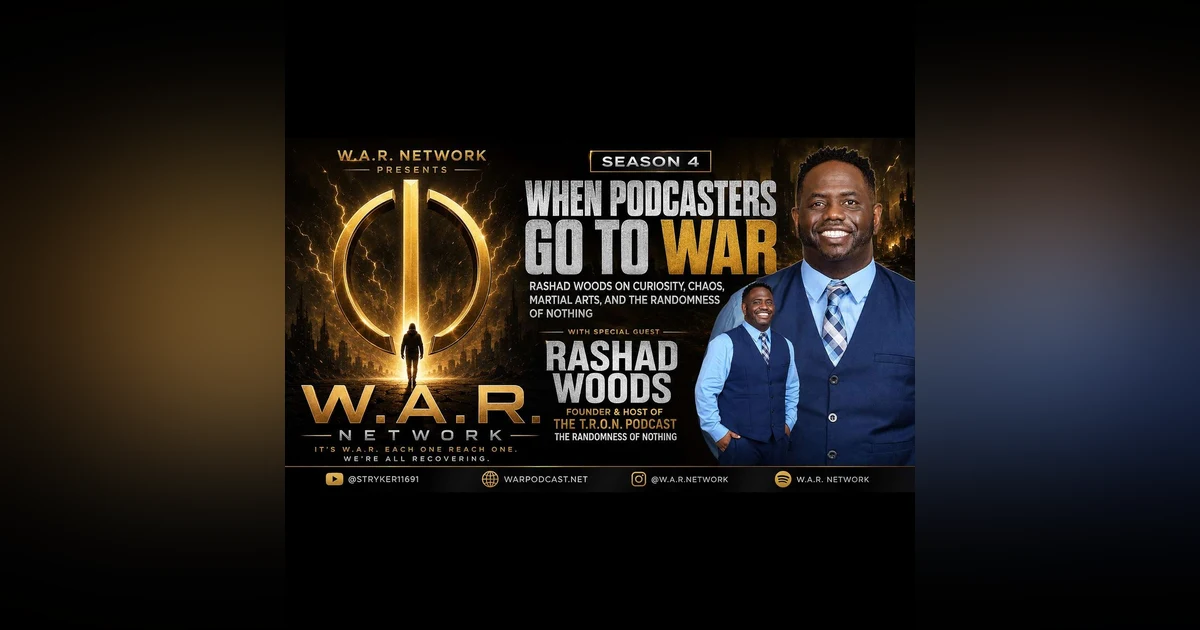
Join W.A.R. Founding Members Curiosity is a superpower, and few podcasters embody it like Rashad Woods. In this episode of W.A.R. Network, Stryker sits down with The T.R.O.N. Podcast host Rashad Woods for an honest conversation about podcasting, martial arts, purpose, discipline, fatherhood, vulnerability, nostalgia, entrepreneurship, and why the best conversations happen when people stop performing and start telling the truth. From growing up in Michigan to earning black belts, building a ...
Curiosity is a superpower, and few podcasters embody it like Rashad Woods.
In this episode of W.A.R. Network, Stryker sits down with The T.R.O.N. Podcast host Rashad Woods for an honest conversation about podcasting, martial arts, purpose, discipline, fatherhood, vulnerability, nostalgia, entrepreneurship, and why the best conversations happen when people stop performing and start telling the truth.
From growing up in Michigan to earning black belts, building a successful podcast, and interviewing people from every walk of life, Rashad shares the lessons that shaped him and the mindset that keeps him asking better questions.
If you've ever wanted to start a podcast, build something meaningful, or simply become more curious about life, this conversation is for you.
Welcome home.
IT'S W.A.R.
Each One Reach One.
We're All Recovering.
#RashadWoods #Podcast #PodcastInterview #Curiosity #MartialArts #Entrepreneur #TRONPodcast #WARNetwork #Stryker #WereAllRecovering
SPEAKER_04
I would challenge everybody that even if it's not necessarily college, you know, to get to take time away from your hometown to be experienced with different people, different cultures, different opinions, because whether you think they're valid or not, whether you think they're invalid or not, there is personal growth that takes place. And then you'll meet some people that you can make friends with your entire life. Most of the time, the people that you are friends with from, you know, K through 8, K through 12, 85% of them you're not going to really talk to after you graduate. It's not because it's not because it's something mean. It's not because somebody did something. It's not because of a falling out. It's because life evolves in that direction.
SPEAKER_00
Exactly.
SPEAKER_04
So that's your second chapter. It doesn't have to be college and we create school. And I enjoy my college experiences. It could be the military, right? Whatever this next stage of life is, don't think that that's the only thing that the world has to offer to you. Right.
SPEAKER_01
Welcome home. Welcome back to War We're All Recovering. My guest today, Rashad Woods, founder and host of the Tron T-R-O-N podcast, The Randomness of Nothing. When I heard that, man, I was like, that's my brain, like most of the time. Yeah. The randomness of nothing, for real.
SPEAKER_02
Yeah.
SPEAKER_01
Rashad talks to entrepreneurs, creators, experts, and people from all different walks of life. He's from Michigan, my best friend from Michigan, he's from Lansing. And he's in the documentaries, history, movies, martial arts, and all the random things that make conversations go from friendly to deep, real fast. So today, we are flipping the mic on him. Rashad, welcome to war. We're all recovering, brother. I appreciate you.
SPEAKER_04
Yeah, it's honestly an honor and a pleasure, and it's weird being asked the questions because typically I have all these things that I'm ready to get you know ready for. And now I gotta be, oh, okay, I'm on the other side of the seat. So to your point, curiosity led me to you and to the platform of podcasting. And it's absolutely therapeutic for me.
SPEAKER_01
Yes, yes. I'm glad you said that because it's therapeutic for me. People ask why I do it. I'm like, man, it's like a huge relief. It just feels so good. Yes. You know, it's very therapeutic. That's why, that's why I love doing this, you know? Yes. All right, so let's get into it, shall we? You know, you host, okay. You host a show called The Randomness of Nothing. I love the name. Like I said, it makes me think of my brain. 2 a.m. in the morning or most of the time. You know, it sounds funny, but it also sounds deeper than people might realize. Where did that name really come from?
SPEAKER_04
Honestly, because I wasn't smart enough to pick one subject to talk about, right? So to your point that two o'clock in the morning, your head spinning every single way, I'll go from watching a documentary on the tsunami in Asia that took place in the mid-2000s, to, you know, listening of hearing about the Colossus of Rhodes, to how food was built in America, to watching X-Men 97, right? So I'm always my mind like being being a geek in the 90s was like, man, what you like that for? And then for some reason in the last like 10, 12 years, it became like, man, you know, I really like that. I just couldn't really talk about that I like, right? So now with social media and podcasting and connecting with people, I grew, you know, it's it's it's more of a normal thing to do and dive into. I had an encyclopedia set in my room as a kid with me and my older brother. So I always would be like, what's this made? How was this about? Where's this location? And your mind got transported without visuals or with limited visuals. And then as the internet, it was like, oh my god, all these places and things are available at my disposal. I'm a kid in a candy store, right?
SPEAKER_01
Yeah, yeah, yeah. I love that because most people act like randomness is a bad thing, you know?
SPEAKER_04
Yeah, it's funny because you can be curious as a kid and you always encourage young kids to ask questions, but then as an adult, you're supposed to turn that thing off, right? And so then it becomes kind of frowned upon. Why is that person always asking things? But you can get what you're what I call zip coded in life, which means that your world is your zip code. It's the same street, the same stores, the same restaurants, the same exact thing every single day. And for some reason your world gets much smaller, right? You know, you mentioned your dog. Well, your dog, what's the first time you open that gate or that door? Boom! Goes right out. He does it all the time. All the time. Yeah. Yeah. Because you're confined. And so then people, you know, they get in that routine. Well, I'm only this in life. I'll never learn more of this. But the way that the internet and you know, platforms that we're recording on right now, it's democratized that process. So you have to go out and seek it. Yeah.
SPEAKER_01
I and I like when you said it transports you, you know, it was transporting you. And I feel like, you know, you know, when you said that, randomness is kind of where the truth comes out, you know? Absolutely. Absolutely. You know? Yeah. I love the the whole random thing.
SPEAKER_04
Yeah, you have an opportunity to, you know, there's enough things that have already been established that have been written, that have been verified, and that you can't, I don't, you know, I don't do politics, but whatever people think didn't or didn't happen, there's enough verifiable proof that the absolute truth does exist. Right. And but what there are also aspects of is you can also discover other people. I've talked to fictional authors, right? You know, authors that do historical fiction. You have to get the history of it right, even if you create fictitious characters within it. So that involves doing history. Did that pen exist? Did that typewriter exist? Did that stagecoaster exist? Because there's somebody who's watching or reading that that knows all that information, right? And so you have to do your homework. Even if you're watching like a regular TV show or a movie, you could be watching, you know, I'm not sure what you watch, but let's say you watch like 1923 on Paramount. There's a historian that's watching 1923 right now that's like, nope, that that lapel didn't exist. Nope, they didn't ride horses. Nope, that leather boot, they didn't have that. So, but that's the beauty of learning about how things operate and function.
SPEAKER_01
It's funny you said Paramount, bro, because I went on this morning to watch some Paramount. I wake up super early and my subscription expires. So I gotta I was pissed off. But somebody told me, somebody told me about 1923. I gotta tap into that.
SPEAKER_04
It's a really, really good show. You know, lately I I'm a big, you know, I jump all over the place, but there's something where westerns and and where, you know, old school stuff where there wasn't a lot of special effects and people have to have dialogue, you know, kind of the the Clint Eastwood kind of character, so to speak. Yeah, yeah. You know, that it kind of, you know, it's it it doesn't get a lot of attention now, but then it had monster ratings when it came out because sometimes people don't know their yearning for it until something comes out, so to speak. Right. Right. And, you know, like I think sometimes people sometimes, you know, particularly companies, they chase what they think people want while ignoring a very big audience right in front of them.
SPEAKER_01
Yeah, yeah, yeah. You're right. And you know something else, man, before we move on, I was just thinking, you know, with this whole random thing. I followed recently a page on my Instagram about random facts. Yes. And which I didn't know. I knew the earth has been extinct for this is something to think about. I know the earth was a stink a few times. I just didn't know how much. So the earth has been in the um had a complete extinction five times, right? Wow. And we're working, we're actually in the sixth one right now. It's ongoing. That's amazing. So it's it's it's like, what? So we it's like in humanity is doing it to ourselves, you know? Absolutely. So it's been causing me crazy anxiety. I'm like, it's just my mind is just everywhere.
SPEAKER_04
Yeah, because then you start to realize, like, okay, what life am I really living in at this exact moment, right? Right, right, right. You know, it's funny you were saying that, and obviously before we move on, I I I think of like sometimes people dismiss rappers, but like listen to like Wu-Tang, particularly like a Jizza, who's really, really deep on stuff like that. Yeah, yeah, right. And you'll be like, you know, some if you actually listen to those lyrics, like, you know, like the basic instructions before leaving Earth, then you'll be like, wow, this guy gave a whole history lesson just in a rap verse, right? So we can't dismiss the source simply because they may make a medium that's you know, oh, you know, it's violent or it does like no, listen to what this person just said. They did that.
SPEAKER_01
It goes completely over people's head, you know? It absolutely does. Yes, yes. Cool, cool. Some of the deepest conversations may happen when you stop trying to sound perfect and just let people talk, you know? Yes, yes. So I appreciate this. Yeah.
SPEAKER_04
Yeah, go ahead, go ahead. No, just briefly, I heard I'll never forget a famous LL Cool J statement. He said, I've never embraced the complexity. He said, What's more complex, the Lord's Prayer or Totsky? And he was like, Sometimes the most deepest thing is in the simplest of statements. Right, right.
SPEAKER_01
That's so true. And I never heard that before. Yeah, he said that in an interview once. Okay, cool. So you describe yourself as someone who is always curious. Yeah. You are in the documentaries like myself. That's my favorite thing to watch, man. Oh, yeah. Is documentaries. Like I could binge watch documentaries all day. Investigation Discovery, Netflix. I don't have anything to watch, bro. I don't have nothing else to watch. I watched all the documentaries, so you're gonna have to tell me something, you know, a few of your favorites, see if I haven't watched them yet. So you into that? Go ahead, go ahead. No, I cut you. I'm so I'm the talker.
SPEAKER_04
No, no, you good, you good, bro.
SPEAKER_01
I want to hear what you have to say.
SPEAKER_04
Yeah, my mind. Damn. So yeah, there's a nine, there's like a five-part series on like Roku has some really good original ones themselves. Right? The actual, like, if you have a Roku TV, they have like they're Bro, bro.
SPEAKER_01
I'm sorry. I can't even, I can't even. This is funny. I I have PTSD from Roku. Oh no. Yeah, that's a I can't. I like the font, the how it starts up, everything about Roku. I can't even see the TV in Walmart. It'd make me nauseous to my stomach. You know, oof.
SPEAKER_03
Yeah, bro. I gotta pick myself off the canvas from that one though.
SPEAKER_01
Yeah, bro. I can't do it. I had to, I got rid of all my Roku TVs, bro. I say far away from Roku. I'll let you this is about you. I'll let you know about that story another time. Yeah, yeah, yeah. That's all.
SPEAKER_04
Well, I'm glad you're okay. So, first of all, thank you, thank you. Having said all that, there's a documentary on there specifically, which was about North Korea and how like how most people like to the average person getting up, turning on television, walking outside, you know, interacting with your smartphone, it's just a day-to-day, you know, thing that we just do. Us talking right now is not some, you know, free, not some magical thing. We just turn on our internet and we have a good day. It's hard to imagine a world where you can't do that. So I did watch a documentary on North Korea. Like, how did this place become this prison cell for the from the rest of the world? And so, you know, there was a four or five-part documentary series of basically, you know, the Korean peninsula, it was overtook by Japan. Then when World War II happened, they divided up on the uh the parallel. I forgot the what the what the name of the parallel is off the top of the show.
SPEAKER_01
I know what you're talking about.
SPEAKER_04
Yeah, yeah. I don't want to get it wrong on your show. And then, you know, Russia and United States said, hey, you know, we'll figure out this this division of the North and the South half of it. Then the Cold War happened, and then as because Russia owned the north end of it, it slowly started taking on more and more communist and and and totalitarian and dictatorship characteristics until it walled off that complete that country completely from the rest of the world. Whereas the South became democratized, had you know, has high-tech companies, internet freedoms, and then you see, long story short, this portion of the world that for many people don't even know that there's another world that exists because they've made themselves deities to their people. You're seeing, you know, people are crying, worshiping their statues, and you're like, dude, this looks like some magneto or a you know, yeah. But it doesn't even seem real, right? And when you watch that and you see what those people are subjected to, you step back and say, it's always not that bad where I got it. Well, now is that in English or It's in English. It's in English, yeah. They have like historians that have, you know, have had some footage access to it. They show some footage, they show some things that are taking place inside of there. So they have enough footage and historical stuff from World War II and modern times, but it's amazing to even like try to wrap your mind around a place like that that exists.
SPEAKER_01
I'm interested, but not interested enough to get a Roku. It might see I'll see if it's on another uh I'm sure it is. Yeah, yeah. I'm gonna check after it.
SPEAKER_04
I don't think it's produced by Roku. I think they just like had it in their library, so it's probably even on YouTube or something like that.
SPEAKER_01
Okay, I'll check Prime. Prime usually have everything. Yeah, yeah, they do. Okay. So with that, you know, the documentaries, everything that you're into, you were talking about kind of being a geek or nerd and everything. You know, you're into why people do what they do. Were you always that type of kid, or did life make you that way?
SPEAKER_04
Well, it's funny, I was always the kid that was told to shut up in school, right? Just like the teachers were like, you know, I wasn't rude, right? Oh, for sure. I wasn't rude, I wasn't disrespectful, you know. But they're like, man, let's just kidding, stop asking all these questions. But I would always, and even like it almost became a challenge for me, like if I was like, okay, if the teacher's telling me something, it it are what they're telling me is true. So I would research it on my own, and then if they wanted, like, no, this actually was this place, and it would be kind of a pseudo-debate, nothing evil, nothing mean. But it almost became like a battle of will. Be like, are you really telling me the truth or are you just giving me something dangerous? Yeah, it's just the truth, right? Like, you know, like, and so it now it becomes I'm uh I I sound like this is gonna sound kind of corny to say this, but unless somebody actually asks me my opinion on something, I don't give it if I know that they're wrong on a topic, because you can sound like that smart, you know, that smart ass, you know, that can, you know, I don't do that. But if they're like, Rashad, what do you think? I'm like, well, you know, actually, it's this instead. And if you're free to look it up yourself, and that's fine. But you know, long story short, I was just always a guy that liked to look stuff up.
SPEAKER_01
And you so you sound like you was one of them kids, you know, turns into an adult who asks questions nobody wants to answer or can't answer. Yeah. Yeah.
SPEAKER_04
And what's funny is it doesn't it doesn't make for a very good uh social network growing up when you're, you know, when you're I mean, I had good friends, right? But when you're trying to play basketball, when you're on the way to attract me, and you know, they're like, well, Shy, what do you think? You know, like you're like, you drink up some random, you know, hey, what do you think about the, you know, how was the kingdom of Hawaii built? And they're like, dude, what the heck, man? Like, seriously, man, like talk about like regular stuff, like it. I'm like, I uh it's just kind of how my brain is wired, man.
SPEAKER_01
Yeah, yeah, that's that's cool. And you're in the right field because that's actually podcasting, you know? It didn't make for a very compelling date night, that's for sure. Yeah, yeah, yeah. Did you ever see, you probably like it, Stranger Things?
SPEAKER_04
Of course. 100%, right? 150%. Great. Because any kid anybody between the ages of 38 to 52 who grew up watching those Stephen King, you know, movie adaptations, Spielberg, James Cameron, you know, Goonies, all related to watching that show. Yes. Right. Yeah. So it was like it took you. I've talked about this ad nauseum with my older brother. I have an older brother who's three and a half years older. There's something that's been lost in the purity of filmmaking, and it's movies and shows like that. There's no cell phones, everything isn't instantaneous. Kids had to like figure out how things were on their own. They were, you know, there's no geo-tracking, there's no instant answer to something. Yeah, yeah. You have to you have to use a map, right? And it you it get on your bicycle and figure things out as they go along, right? It's those little things that, you know, even like a blockbuster, right? There's something that's missed in being able on a Friday night to walk, ride your bike, stand in line, look at what the library catalog has to offer, take the movie home, sit with your family, and yes. There that there's a level of communication and interaction that has been lost because people don't do that anymore.
SPEAKER_01
Yes, yes. I miss Blockbuster, man. Very badly. You know, the smell of it, the carpets, everything. You know, it was exciting to go in there and see the new releases and stuff like that. You know, I miss stuff.
SPEAKER_04
Yeah. And and then, you know, or when you had there was a movie that was big dropping that weekend, and you knew every copy was out, and then somebody was walking in, returning it right when you were at the checkout, and you're like Yes, yes, yes, yes.
SPEAKER_01
Those little things. Yeah. Great memories, great memories. Very good memories. We'll never get that back, man. AI taking over everything.
SPEAKER_04
Absolutely. Absolutely.
SPEAKER_01
Yeah, so you grew up in Excuse me. You good? You grew up in Romulus, Michigan. Is it Romulus or Romulus?
SPEAKER_04
Romulus, yeah. Romulus.
SPEAKER_01
Right outside of Detroit. Right outside Detroit. That's why I wanted to ask you, like, how did that environment, how was that environment? Was it like Detroit, you know, like the suburbs of Detroit? Was it dangerous like Detroit, you know?
SPEAKER_04
It's it's it's it's it's it's straight suburbs, right? Like Romulus and Remus, who were the founders of Rome that were birthed from a wolf, and they were little, you know, so it's where the airport is actually located, right? So when they say Metro Detroit Airport, that's actually where you land. You land in Romulus, right? It's quiet, it's it's quiet town, USA, regular, you know, you know, nine to five blue class working town, you know, regular people. There's, you know, not I'm not gonna, you know, sit back and say it was it's not it's just it's just a regular town, you know, with great people. I still live about fift 25 minutes away from there right now. But you know, what that did was it instilled in me that if you actually put your mind in good places from my parents and my brother, that you can accomplish good things, right? And so it's funny because I have three daughters, and while they play sports, they're not obsessed with sports, right? And it's you know, I was obsessed with playing basketball. But, you know, there's beauty, and when like my oldest daughter downloads like a app that's a French app, right? And I'm like, wow, this girl downloaded Duolingual or Pimsler and wants to actually learn French. I'm like, you know, because I think like that DNA was kind of passed along, so to speak, and it kind of resonates with them because that's the things that they see even me talk about. And so that helps. Kind of like I kind of did my job a little bit, you know what I mean?
SPEAKER_01
Yeah, yeah, that's real. That's real, man. And I'm when you said duolingo and all, it just now I'm thinking random thoughts and stuff like that. I'm thinking about this uh chip that Elon Musk is is is uh I guess is in trial periods now. It's called Neuros something.
SPEAKER_04
I did hear about that. Yeah, it goes in your brain or something like that.
SPEAKER_01
Yeah, it goes in your brain, but it's supposed to give you the ability uh for humans to be able to speak every language that they want. Well, they can have thought that sure it's a heck of a product. With all due respect, you're not cracking my head open.
SPEAKER_04
That's crazy, right? Can you imagine that? Yeah, I mean, you know, and and there's people, you know, there's neurologists and scientists that obviously are always people always look at the day, the week, and the month. Innovators and businesses and creators think decades in advance. You know, they're always in, you know, and and I'm sure somewhere that there may be some value in that, but that's, you know, and they obviously have researched that, but they've there, I'm sure somewhere that there's a there's a person willing to see and put their livelihood on the line, their life on the line to see if it works.
SPEAKER_01
Yes, yes. Okay. I'm looking at my dog, he's chewing on wires and stuff. No, so I guess you went to Michigan State University. I did. My best friend will love that. He he's Michigan all the way. You can't tell him nothing about anything in Michigan. Yeah. Michigan is the greatest state ever. Yeah, according to him.
SPEAKER_02
Yeah.
SPEAKER_01
Anyway, what did college expose you to, you know, that your hometown could not?
SPEAKER_04
I, you know, you find out you have a lot more free time on your hands that you didn't have before, right? So, like, and then you have to get out of your comfort zone. I would challenge everybody that even if it's not necessarily college, you know, to get to take time away from your hometown to be experienced with different people, different cultures, different opinions, because whether you think they're valid or not, whether you think they're invalid or not, there is personal growth that takes place. And then you'll meet some people that you can make friends with your entire life. Most of the time, the people that you are friends with from you know, K through 8, K through 12, 85% of them you're not going to really talk to after you graduate. It's not because it's not because it's something mean, it's not because somebody did something, it's not because of a falling out, it's because life evolves in that direction.
SPEAKER_00
Exactly.
SPEAKER_04
So that's your second chapter. It doesn't have to be college. We create school. And I enjoy my college experiences. It could be the military, right? Whatever this next stage of life is, don't think that that's the only thing that the world has to offer to you.
SPEAKER_01
Right. And that's powerful because sometimes growth isn't about becoming somebody different, you know? It's sometimes about realizing the world is bigger than a block. Yes, you know, bigger than that school, bigger than that city, bigger than that version of yourself, you know. Yes, absolutely. So that's powerful, bro.
SPEAKER_04
You don't realize how minuscule your world truly is until you actually see everything else moving, irregardless of the world that you have come from, right? You know, you think you're smart until you go to college and there's this 18-year-old that's already studying astrophysics. You're like, oh my God. Wow. You know, and you're like, damn. You know, I remember I went to an engineering camp when I was like 16, and I went to, you know, it was at U of M, not Michigan State, the rival schools. And I was like, I didn't want to be an engineer. My parents made me go, and I'm like, yeah, real quick, I said, I can't hold. I knew at 16, 15, I'm like, I can't hold a candle to these kids. I don't have first of all, I wasn't passionate about it. And second of all, their math and science aptitude was here and mine was down here. Yeah, bro. I feel you to the heart.
SPEAKER_01
I was dang. It hurt. Yeah, I I could completely understand, trust me. Yeah. Yeah, man. You gotta have me on your podcast, bro.
SPEAKER_04
I got some things to talk about. Yeah, that you're that's what that's what I do this for. You know, and it's funny because I'm not a guest enough on people's show, right? Because you can get caught up in just booking the next one, booking the next one, booking the next one. Right, right. And you never you never slow down and actually assess what you're doing, try to actually formulate your thoughts, what's the next stage of evolution? Because to your point, everything can kind of autopilot. You know, if you know that you can at least structure an interview, you know, did I plateau just structuring interviews and not actually say, hey, I need to be a guest, pass knowledge on and get my my brand and my name out in other avenues by being a guest. It it it's it's and if you're doing it by yourself, it's not like you can tell your partner, like, hey man, go up be on here and expand the show.
SPEAKER_01
Yeah, that's a good idea, man, because I've been getting invites to be on people podcasts, and I'm just like, I don't have the time. When do I have the time? And you know, I haven't been following them up, but like, you know, to get my message out there is probably a good idea, you know?
SPEAKER_04
You have to listen, it's such a crowded space, and sometimes it it is and it's competitive. And when we talked about that democratization, all you need is your cell phone. You could be in your car, you could be in your basement, you could be in a closet, you could do it on your lunch break from work. You don't need to, you know, the the gatekeepers now to get to that next level, you may need like a network or something backing you, but the barrier to entry is very small, right? Yeah, yeah. So, in order to get that ecosystem where you are at the highest level, you hate you can't just be a host all the time unless you are a superb subject matter expert on a very high-level requested topic. Like if you're the finance guru, if you're the fitness guru, then maybe you can go ahead and just be the host because people are looking to get a specific service from you because of that specialized skill. But if you're me, where you're kind of just all over the place and you know, kind of like, and you got to be a little bit of everything.
SPEAKER_01
Yeah, that's great. That's great insight and great advice. Yeah, you needed that. Yeah, your podcast is built around meaningful conversations. Let's but let's be honest, Rashad. Let's be honest.
SPEAKER_03
Yeah.
SPEAKER_01
Everybody thinks they could podcast now, right? Oh my gosh. Everybody. Oh, yeah. You know? What set yeah, what separates a real conversation from two people just talking in the microphones?
SPEAKER_04
You know, it's funny because I think that because everybody thinks it's easy, what this is what I learned. They said most people stop after 18 or 20 episodes. So if you can make it past 18 or 20, you know you're on at least something of substance of some level. What that is, I don't know. But you do have to, by by centering my topics for me specifically, around people who do and create, I get a chance to talk to you if you're an ex-military veteran who's now created a business, a dancer, an actress, a CEO, you know, if you built a fourth Fortune 500 company, if you built a small business, and now you have customers that are worldwide, if you're a consulting agency. So that allows me to keep the conversation flowing and interesting because everybody who has a business isn't on a billboard, isn't, you know, doesn't have 500,000 Facebook followers, but by itself is a very successful business with a high level and high satisfied level of customers. You just have to seek those people out. Right. So that's what that's what keeps my conversations, I think, to my best ability, fresh and innovative, I would hope.
SPEAKER_01
Yeah, you know, let's be honest. A mic don't make you interesting, you know.
SPEAKER_04
Just like a mic don't make you a rapper. You better listen, man. Right, right. Everybody thinks they can sing, you know, but like you know, until you get a vocal coach, until you have to have breath control, until you have to structure songs. Right. There's a million people out there that there's not a lot of people that can get people to listen to their music, pay to listen. Right, there's differences in that, right? Yes. Yes. Definitely.
SPEAKER_01
And uh and in in my opinion, a podcast only works when somebody, you know, is willing to stop performing and actually say something true. Exactly.
SPEAKER_04
Exactly. And and the other thing too about it is I had to learn there's a little timer that goes in my head. If I've talked more than 20 seconds, 25 seconds, shut up and let them talk. Right. I always and that's difficult because if you really want to ask a question, if you're really fascinated by something, you know, I always say I pause, I said, Hey, I'm sorry if I'm over talking you, I'll stop right now. So there's always a moment in my mind that I'm like, I need to make sure that they get adequate time for themselves to speak.
SPEAKER_01
Right, right. And I've had guests uh like apologize to me and say, sorry if I'm talking. I'm like, no, bro, go on. This is you. This is your interview.
SPEAKER_04
Yes, yes you know, so and people want to be validated. Even the most, it it like it's so funny. Like, you think of like an actor or actress or an NBA player, NFL athlete, and they're like, I always wanted that Oscripts. Like, dude, you sell out, you you sell millions of tickets, you made a $20 million movie salary. They're like, I always wanted that Oscripts because I wanted that validation. You know, you know, or if they won the Super Bowl but they didn't get the MVP, they're they'll be mad. You think Michael Jordan would have been happy if he didn't get finals MVP? Like you really you really think like, hey dude, you already won the championship. No, he would have been pissed. Now, there's levels to people like most of us will never touch that level of like we can't jump that high, run that fast. That's God-given talent of one in a billion that ever exists. But having said all that, those he wanted validation. You know, I am the MVP, right? So people who are interviewed, even if they have a great business and they don't know me from from from a hole in the wall, they want validation of what they did. Right.
SPEAKER_01
Right. I'm I'm over here cracking up, bro. I got so I have so much to say to you. Yeah, I understand. It's funny, man. It's funny what you say because it's so true.
unknown
Yeah.
SPEAKER_03
Validation.
SPEAKER_01
Yeah, man.
SPEAKER_03
Yeah, you know, yeah, yeah. Why do you exist if you don't go ahead. Go ahead, dude.
SPEAKER_04
People don't people don't do anything. They can say whatever they want. I don't care who you are from what walk in life. People want validation for what they did. They don't come on a podcast, have a successful business, and not get on your show when they they they have a business to run. They are perfectly fine doing the things that they do. They come on your show to be validated for what they did.
SPEAKER_01
Yeah, yeah. It makes sense. Total sense. Yeah. Okay, yeah, I love it. What's the biggest lie people you think uh tell themselves before they take a risk? They confuse a habit for hard work.
SPEAKER_04
Right. So they can't. Go into that. Yeah. And listen, I won't say that unless I lived it myself, right? So it's like working out. And I always use the example of working out. Just because you go to the gym doesn't mean you're all in on getting in shape. So that means that you have to eat right. That means you have to watch your calorie intake. That means you have to be conscious of whether or not there's the ice cream and Netflix or the treadmill downstairs seeing you in the face. Right. I went to the gym. I I go to the gym three or four days a week, but I haven't lost a pound. Okay. Ask yourself this one question. What are you eating? It's a very simple question, right? And and you're like, ooh, yeah, I had the bacon sausage, eggs, and you know, uh, you know, English muffin for breakfast. Well, that's your first mistake. Right? That's that started like that's the beginning of your mistake. So that's already like almost 2,000 calories right there. Then you had for lunch whatever you had for lunch, and you had your snack, then you had your dinner, then you went to bed and had another snack. So you already have 5,000 calories. I'm not hating. I'm not. Like, I don't judge. That's not my Bro, you drop you dropped the science, bro. You know what I mean? That's not that's not what I do. I don't tell nobody what to do, you know what I mean? But having said all that, if your goal was to get down to a certain weight or look a certain way, the gym was only one portion of the equation. So, you know, to your similar when people want to start a business, just because I'm working hard at it, just because I'm taking time at it, doesn't mean I'm working hard on it. Right? Am I willing to work on something when there's no immediate gratification? Am I willing to work on something when I'm by myself and it's 85 degrees outside and it's really nice, and I would rather, you know, be outside instead of sitting behind this laptop and working on something. That's when your real you is gonna come out.
SPEAKER_01
You know, I think a lot of people say to themselves, I'm waiting for the right time, you know, New Year's resolution, something like that, you know. Don't do it.
SPEAKER_04
You're lying to yourself, and it's coming from a guy who lied to himself, you know. I got a chance to go to Beverly Hills for a photo shoot. I started in my basement, and I'm not Joe Rogan status by any stretch of the imagination, but I've my show has climbed to where people I get Fortune 500, I get CEOs that are reaching out to me. I got people that have been on the Nasdaq that reach out to me, I got people that have been on Shark Tech that are reaching out to me. It's not because I did anything special, it's because I stuck with it. Right? Like discipline, bro. And listen, for anybody, one of your listeners, it sucks sometimes. It's straight up honest to God, you are tired, you've done two shows, you're like, oh man, I got another email. You know, I don't care who you are. If you're getting in shape, Tom Brady has been there, Peyton Manning's been there. They will tell you, like, getting up at six o'clock in the morning to get in shape was not easy, right? Yeah. Doing shows and episodes and recording and being prepared and editing and posting is not easy. It's very difficult. And but it's supposed to be. So my goal isn't to necessarily be the best show. My job is my job is to outlast everybody who quit.
SPEAKER_01
Yes, sir. I love it, man. You dropping, you dropping knowledge right now. Appreciate it. And I'm gonna I'm gonna I'm gonna keep it 100 right now. Like my thing was I was waiting to feel fearless, you know? And I was like, I realized after a moment that day it's not coming. Never I gotta move scared sometimes, you know. Terrified.
SPEAKER_04
Terrified. Yep. My first goal when I first did my because here's the thing people always told me, hey man, you talk or like, dang, man, he's always talkative. That doesn't mean I was necessarily gonna be a good host, right? Just because I like to ask a lot of questions or have a decent conversation doesn't mean you're camera ready. Doesn't mean you're interview ready. Doesn't mean you can make a back and forth conversation seem natural, not and not and not scripted. You know what I mean? So like it's almost like just because the rapper can freestyle doesn't mean he can make an album, right? I mean, it's true. You know what I mean? Like, how many guys were like, oh man, he's a great mixtape rapper, and then next you know, you're like, man, you know, he don't know how to make songs.
SPEAKER_01
Yeah, yeah, yeah.
SPEAKER_04
Yep. Sometimes you gotta be that entertainer too, you know? Yes, yes. And so now, you know, you've heard stories where like, you know, like guys were like, I had to learn how to write songs. I had to learn that it wasn't just rattle, rattle, rattle off the top of my head. Yeah. But no, you have to, you have to be compelling. You have to give something to people to listen for. And now with this era that we live in where you have like six seconds, three seconds to capture somebody's attention, if you can't do that, they're going on to the next podcast. They're going on to the next YouTube video, yeah, they're going on to the next whatever it is that they have at their disposal. Even the biggest of brands, your McDonald's, right? People see that line, Burger King is right next to me I wasn't in the mood for Burger King, but it's cool. There's only six people there instead of 20.
SPEAKER_01
Yup. Right. Yup, yep. So you're talking facts, man, talking a lot of facts right now.
SPEAKER_04
Yeah. If you want a knee filled, real quick, and you just want Burger, fry, and shake, it doesn't really matter if it's McDonald's, maybe to the kid, the McDonald's experience, but to the dad or the mom behind the wheel on the road, it's the same, it's the same thing.
SPEAKER_01
Same thing. Exact same thing. Yes, sir. I want to keep it, I want, I want you to keep it real with uh right now, Rashad. I know you all, but you don't have to answer this if you don't want to. Yeah. You know, your show has a lot of guests, but I want to get into to something, you know, that podcaster the podcaster. You know, what kind of guests drains you?
SPEAKER_04
You know, like I will say I've had the fortunate distinct real talk. You know, I don't I I have a decent vetting process without coming across as like rude. So I don't do rel like I do I don't do religion or politics. So that keeps that that keeps that draining experience at bay. Right. So it's like, listen, you know, if it's historical or if you have like your career intertwined with like a, you know, something, something that involved that, like, hey, I was a rabbi, but I became like, you know, an excavator, or or it, you know, I was a curator at a museum, then that's something that's perfectly valid, right? But if you're gonna talk about like, you know, whether or not somebody's religious viewpoint is more valid than another one, or if you're trying to be like, this is the reason why I support this particular candidate or don't support this particular candidate, I don't do those episodes. I have no intention, like, because that in itself is a draining experience for me. I really like there's these people spend all these time, people in general on the internet arguing political opinions. It's like you do realize they're never gonna change their mind. Like, are you are you fully understanding of that? And sometimes they're just trolling you because then you know that, and they would rather find joy in making you mad than actually having a valid opinion or point to be made, right? Yeah, so and I'm not here to and that's on any side of any thought that's made, period. So I don't I I stay away from it. I I've told people before I don't do that because it's just not worth my time. And it's kept me kind of in that safe space because kind of selfishly, it's my show, and I don't have to do it.
SPEAKER_01
Yeah, yeah. Yep. That's why I gotta start thinking that way, man. I know exactly what you mean. Can't do it.
SPEAKER_04
No, no, it's it's it's but there's enough places for people to do that. There's enough valid shows like that, but I don't want because here's here's what'll happen. Like eventually, if you get big, they'll say, I heard that episode was such and such, and I have to say, you know, refute that opinion, and then next thing you know, you could become a debate show. I'm not, I don't want no parts of no debate show. I don't want to hear about anybody's, you know, going back and forth, and I'm the moderator. I'm not doing nothing like that.
SPEAKER_01
Right, right. Man, thank you for that. I I appreciate that, man. I I I took that in because, you know, mine is that guest who answers every question like they read in a LinkedIn bio. Yeah, that's a rough one, too.
SPEAKER_04
That's a rough one.
SPEAKER_01
You say, What broke you? And they'll say, Well, my mission statement is no, bro. Come come back to Earth. Come back to Earth, you know? Right. That drives me nuts, man. And it it draw it drove me to the point where season three, at the end of season three, I took, I took a break. I understand. I said, man, I gotta re- I gotta, you know, think of something, how to do something different. Yeah, reprogram. I'm gonna start dropping seasons like they do in TV series, if that's the case, you know? Yeah.
SPEAKER_04
Year after year. You know, the only reason I haven't done that, it's funny. Like, I have I literally, I'm still technically on season one and I'm like 205 episodes in, right? Because not joking. Like, you know, because like it's weird because my biggest problem is I have a hard time saying no. Like, I'm guessing in my mind, like I'm concerned about momentum stall because I'm always like, man, they can always go somewhere else, right? And there are some things I want the show to evolve into. Like in a perfect case scenario, I want to start getting live on site at businesses and be like, show me how this operates and functions for our audience. Let's do a live episode. Like, if you have like a, you know, like a cylinder or some sort of you know, plant or facility or you know, item that you want to deploy, let's do a special episode so that way we can broadcast this particular product or service in kind of a live setting because that can that can push you past just being and you know doing a show over a reporting software.
SPEAKER_01
Yes, yes. That's what I'm I'm leaning towards, you know, doing in person.
SPEAKER_04
It's hard.
SPEAKER_01
You know, yeah.
SPEAKER_04
It's hard, man. Like it's you know, you gotta you got the logistics of it are not easy unless you just happen to know that business owner right around the corner and you can just pop right in. But having said all that, it takes time. And you know, if you have energy balancing life commitments and everything else and family, it's not, you know, you may have to get a cameraman. So there's a lot of steps that are involved with stuff like that.
SPEAKER_01
Yeah, definitely, definitely. So on the flip side, what is the type of guest that surprises you in the best way?
SPEAKER_04
Yeah. I think that when you find out, like I literally just interviewed a woman that has her own consulting business. She had a lifetime presidential achievement award, and and you know, she she her father was a Buffalo soldier. So it was like amazing. She's been to Korea. And unless you get the bio of these people, there are people that have accomplishments that are just absolutely amazing, that may not have a Wikipedia page. Her name's Luana Bradford. So I want to make sure that I say her name on your show. But you just because they're not, you know, in your immediate Google search doesn't mean they don't have plaques on their walls of big major, you know what I mean? So like and that's the beauty of doing podcasting and connecting with people because sometimes when you see what people have accomplished, it makes you step your game up. And you'll be like, you know what? Okay. I bet I I gotta be on point. Like, you know, you've interviewed people and you'd be like, damn, you know, they really got something going. I better be prepared on this interview because, you know, when you start interviewing CEOs and head high-level people, you gotta know two things. They don't give their time to everybody, and you better be prepared.
SPEAKER_01
Right. Yep, definitely. And those are the ones I love too, you know. A person when they drop, you don't know, you read it, you read their bio and everything, you do a little research, but then they drop something, you know, that makes, you know, that just makes you like, like, wow, just astonished. Like, yeah, yeah, I love those people. Oh yeah.
SPEAKER_04
And you know, and it's tough to really like understand sometimes why did you reach out to me? Like, you know, when they get on, you'll be like, what out of all the things that you I ask them sometimes, why did you want to be on my show? And they'd be like, I you know, you were fascinating, and I listened to a couple things you said, and you're like, okay, I'm doing the right thing. Okay, I, you know, you know, I'll never get I'll never get egotistical, you know, that people want to be on my show because listen, man, you know, they can be doing a lot of other different things, other than talking to a stranger they just met and listened to a couple things and kind of felt like there was a good connection.
SPEAKER_01
Yeah, and that's when you know your conversations found blood, you know? Yep. So yeah, I dig it, man. I dig it. And as a host, have you ever been in an interview where you thought, no. No, yeah, this is going no, this is going nowhere.
SPEAKER_04
Yeah, I had one. Uh uh for the sake of uh of privacy, I won't mention the person. Yeah, yeah. I kind I kind of knew when I took the booking, I did it to myself, but you know, I was like, okay, I'll give this one a shot. And then about 20 minutes into it, when they kept talking and kept talking, I was like, man, this is this is a rough one. And then I they could they couldn't get the hint that I was trying to off-ramp the conversation, right? Right, right. Just because I'm like, number one, I could never get a word in. Number two, it just kept kind of rambling. I'm like, yeah, this is this is a rough one. You know, and I but again, I'm my own worst judge because my own word of credit because I had a responsibility to say no. That was my fault. Right, right. It wasn't their fault.
SPEAKER_01
Yeah, you said you have a problem saying no. I did. No, that's me too. Uh, you know, I completely get it.
SPEAKER_04
And I said I'll and I was like, I'll be I was just like, man, I I remember after it got over, I was like, yeah, I was like, yeah, I don't, I'm not putting my, I'm not saying I'm not doing that again. You know.
SPEAKER_03
Yeah, yeah, yeah. Yeah. I completely understand.
SPEAKER_04
And it wasn't because, you know, it just wasn't a good fit. It wasn't, you know, it wasn't me, it wasn't that particular person. They weren't mean. It just was like, man, this is really not my cup of tea.
SPEAKER_01
Yeah, and you sitting there smiling, yeah, nodding, but but inside you like fighting for your life.
SPEAKER_04
You know, and and you know, and Yeah, and full, you know, and one of the things is that, you know, but but I I could tell you one thing, some of the greatest reporters in the that ever existed will probably say afterwards, like, man, you know, I probably shouldn't have done that one. So if I can say five, you know, it's almost like bless his soul, Charlie Murphy. Well, they said one time he he did an interview when he was alive, and he said he was complaining he got booed. And he said he was talking to his brother Eddie, and Eddie was like, Who the heck do you think you are? He was like, Charlie Murphy. He's like, Richard Pryor got booed, I got booed, and he listed all the great comedians. He's like, So you better deal with it. So, like, anytime you're going through it to try to actually accomplish something, the people at the top of the mountain went through it. So you can't sit back and be like, Oh man, this ain't never happened to nobody. I don't know where I'm going here. You know, Tom Brady got picked as one of the dead last picks in the draft, right? You think that guy didn't have a chip on his shoulder? You know. Now look at that. Right. Peyton Manning was the number one pick, and he was flopping for the first five or six years in his in his playoffs. And then finally, you know, like he finally put it together, but people don't remember all the the flops. They only remember the two Super Bowl rings now, right?
SPEAKER_01
Yeah, definitely.
SPEAKER_04
People don't remember that Tom Brady was the last pick. All they remember is he's the GOAT. So but they went through it, right? You know, from the guy dead last to the guy that's first.
SPEAKER_01
So hey, you gotta go through it, man. So tell me, Rashad, put me on, man. Like, like, how do you save a dead conversation?
SPEAKER_04
You know, it it that's like interesting.
SPEAKER_01
Give me a technique.
SPEAKER_04
It's humor. Humor. Humor. And it regardless of whether make sure you listen because sometimes you can reference something back from the beginning. Because it's very easy to check out mentally when the conversation is going nowhere, and then there's that dead space. But if you remembered something from the very beginning, you'd be like, man, that kind of reminded me of what you said earlier. And then it kind of like fills that gap and right, and then you could be like, okay, well, maybe this wasn't the most compelling interview, but at least I didn't disrespect them. Right. In all seriousness, I don't ever want in the small world ecospace that I take up, I don't want nobody feeling disrespected on my show. Yeah. You know what I mean? Like, you know, like because when you start, you know, I I don't ask them, you know, personal questions, they feel like revealing it, cool. But like the the key is really just to operate in good faith, right? Just to operate in basic good faith. And if you don't know what that is, then you never then you don't then that's something that you just don't need to be doing. Operate in good faith. Answer the questions of what they had on their bio, you know, go into there. And then the second stool to it is I don't look into like anything deeper. I'll watch like their YouTube clips, I'll watch how they speak, what they said in a sense. You know, that helps those dead gaps too, because maybe they were at a TED talk, maybe they were they did a public conference. So you can reference that inside of the actual conversation you're having to let them know that they are interesting to you for the time that they did carve out of their schedule.
SPEAKER_01
Yeah, yeah. I was just thinking that. Yeah, you gotta do it. Yeah, and humor is great, you know, because sometimes the best thing you could do is humor. Absolutely. And do something humorous and and human and you know, kind of, you know, take that edge off.
SPEAKER_04
Absolutely. I agree. You know, and I think I think too is that when you build up enough of a library, sometimes people kind of see what your style is. You're not confrontational, you're not probing, asking any personal questions. They kind of get a feel of who you are and where you're coming from, and so they kind of feel comfortable talking to you, right?
SPEAKER_01
Yeah, bro. I've been waiting the the I gotta ask you about Tang Soo Do. Yes. Is it Tang Soo Do or Tang So Tang So? Tang Sudo. Tong Tang Sudo, black belt. Yeah, thanks. This guy, guys, he practices martial arts. Yeah. Yeah. Uh you would just kick my butt up and down the street. I don't want to fight. I'm not trying to fight. I'm not trying to fight nobody, you know what I'm saying? Yeah, but you know, like I was looking when I see your uh picture, I did not until I started reading your bio and stuff. I was like, you went, I couldn't tell you there was a black belt and taekwondo, a brown belt and taekwondo and all this. Yeah. And you train a Brazilian jujitsu and movie tie.
SPEAKER_04
Yeah.
SPEAKER_01
Well, that's crazy, bro.
SPEAKER_04
Yeah, appreciate that.
SPEAKER_01
Where did you have the time? Like, how did you like how has martial arts shaped the way you handle life and and everything like that?
SPEAKER_04
Well, two things before we get off of who I can't and can't beat up. I'm not a pro fighter. I've done I've done turn, I'm not an amateur. I've done tournaments, though. I had I used to do tournaments all the time when I was in college when I was doing Take One No, right? So won a couple medals, right? Just local regional ones and stuff like that. One was kind of a state level one, but I did really well in that. But let me let me preface with this most people who are talented in martial arts do not look like the guy that could really like do damage to you, right? Right, right. You know, I have trained with people, but you'd be like, Are you serious? You can really do that. So I I got in, I got into martial arts. I was playing, I used to play basketball all the time. My brother got me into martial arts, right? So we watched like the Van Dam movies, the Bruce Lee movies, all that. So he got into it at about age 11, 12. I got into it about age eight, seven, somewhere around there. About yeah, about seven or eight. I did it for about two and a half years, but then I was like, I'm going back to playing basketball. I was, you know, I'm a kid because team sport, you know, everybody thinks that's the Jordan era where you think you're actually gonna be something in basketball. Full disclosure, right? I didn't amount to anything. So then I get to college, and I you have that free time we talked about earlier on hands. I said, man, I kind of enjoyed martial arts, and then I was like, man, let me get back into it. So then I got back into it in my freshman year, really like started to fall back in love with it, you know, did tournaments through college, did Taekwondo, got my brown belt in college, graduated, life happens, then you fatherhood, and then I'm like, now you're back to being a little bored again, and you're like, you know, I gotta get something that I can get myself back into. There was a tung Sudo. Tong Sudo is actually the original art. Taekwondo branched off from Take from Tong Sudo. Okay. Right. So right. They wanted to unify. It's funny we talked about Korea earlier. They want there were nine Kwans, which were nine martial arts style. They wanted to unify one specific style in Korea. But Grandmaster Huang Ki, who created who created Tong Sudo, said, I decline, I don't want to make this a national sport. So he the original sports, the original style stayed in Tung Sudo while everybody else did Taekwondo. So I found a Tung Sudo school that was actually right around the corner from my house, which was cool because it was similar to what I was doing before, which was on my feet, striking, kicks, his punch, you know, joint locks, elbows, etc. Uh it's karate, right? You know, kind of like Shotokan karate. Right, right. So got my it took me a while to get my black belt on that. But like anything else, I wanted to learn other things. I had practiced intermittent styles in between then. And then I was like, okay, I've never really been on the ground. So when I was in college, I did a semester of judo, and I was like, oh my God, I got absolutely annihilated. It was all brutal. I didn't because I didn't wrestle, right? And so then I'm just getting murdered on the ground. So then I was like, let me branch off into jujitsu. I'm not great at it. I haven't been in a couple months, but I was practicing pretty heavily for about three years. Place is still right around the corner from my house. I just haven't been there since like March. Life and everything else that happens. My kids have had have a lot of activities. And then in between then, I was doing Mui Thai too, you know, the Thailand style where it's the elbows and knees. So long story short, I've just always been a martial arts freak, you know.
SPEAKER_01
And that that's fascinating, man. Like, which came, what was first, and which, like, what did you do after? Like, tell me the uh the uh the order? Yeah, the order that you uh did it in.
SPEAKER_04
Taekwondo first was my first introduction when I was seven, eight, nine years old. Taekwondo in college, tongue sudo when I was about 30. Actually, in between then, I was still I did boxing for a little bit, like in my early 20s, just trained nothing serious. I there was a gym. Then in my 30s, when I was getting a little more serious back into it, wanted to get my black belt because I always trained with black belts, but I never got mine myself. So then I was doing, I got back into tung sudo. My brother was training in a Japanese style. He had his black belt in Ishinryu, and a good friend of ours co-owned the gym that I would train with them in between in my 20s. I would train with them. So then in between, then I did like a Filipino style, like uh it's called Panatukin. So really short story. Take one though, Tung Sudo, then Brazilian jujitsu, then Muay Thai, and boxing in between.
SPEAKER_01
Bro, yeah, that's that's amazing, bro. That's amazing. And uh just a random thought, when Muay Thai, I was in Thailand one time and I was at a bar and they had in Padia, Thailand, and it's like an outdoor, indoor type of bar, and they have a Muay Thai ring in the middle of the bar, and they got the bar that it it kind of like in a box. Yeah, it's kind of like in a square, and the ring is inside, and they will have these little dudes in there just beating the crap out of each other. Killers. Yes, killers, yes, yes, bro. Killers, straight killers, like blood flying everywhere, people cheering, and they just kicking each other, they're killing each other.
SPEAKER_04
You ain't you have not like I do that's the part where I said there's levels, right? Like, I'm good enough to defend myself against somebody that's trying to do me harm in an everyday activity. I'm good enough. I've trained with people who are like uh do high-level amateurs or trying to aspire to be pros. And I at some point, and I'm not I'm not up-leveling my skills on any level, I can hang in a in a touch and go session, you know, like that. Right, right. If they turn it up, I don't have that gear. I don't have that gear, you know what I mean? Like, you know, I can I I'm good enough to be competent, I'm good enough to like give you some reps. But if you're trying to, you know, I'm not in my 20s where I was really like heavily doing tournaments all the time. When I was doing tournaments in my 20s, you know, in college, like I got really intense. At this point, man, I'm 43. I don't want a broken nose, I don't want broken ribs.
SPEAKER_03
Yeah, yeah.
SPEAKER_04
Like I'm very, I'm, you know, I'm on the other side of the fence, keeping shape and maintaining what I got and try not to lose anything.
SPEAKER_01
Yeah, that's why I respect martial arts, man. Yeah. It humbles, it humbles people.
SPEAKER_04
Listen, and again, full disclosure for people who are listening on this show, not one is more superior than the other. Just take something as a get out of jail free card. You know, don't be dismissive. I don't, you know, jujitsu is better than there are there are, you know, or karate's better. All you have to do is be able to stop somebody from doing you harm in the quickest manner possible, and then leaving as quickly as possible.
SPEAKER_01
As quickly as possible. So you could be loud, successful, whatever, and somebody folds you up like laundry.
SPEAKER_04
And full disclosure, man, that's in the back of my mind too, because like the nine-descript dude that you don't know that that's really like I'm telling you, I've trained with dudes that literally look like the Todd the accountant on the third floor. And you and then next you know, they've got you triangle choked and stuff. You put all my, you know, so I don't I don't play those games, and then I'm not trying to get world starred. I'm not.
SPEAKER_01
Yeah. Yeah.
SPEAKER_03
You know.
SPEAKER_01
Yeah, man. That's funny. I got a funny question. Like, what's worse getting caught in a chokehole or editing a bad episode?
SPEAKER_04
Yeah, it's I would I would say getting editing a bad episode because a chokehole, you know, like yeah, I mean I always say that because when you do a bad, when, when you do a bad episode, you're going, man, I made somebody look bad. You know, you're getting choked out. Anybody I I would never train with anybody at all who said they've never been clipped or choked out. I won't do it. Because I don't tell me in in all your years of training, you never got you never took a flush punch in the face, you never got choked out, you never got like somebody was giving you the business.
SPEAKER_01
It's statistically impossible. Impossible. Right. And at least a chokehold you could tap out. You know what I'm saying? Exactly.
SPEAKER_04
Amazing. And listen, I've been put to sleep. You know what I mean?
SPEAKER_01
Like you just wake up, you'd be like, that's the name of the game, baby. Yeah. Okay, okay. Winding it down, winding it down. I still have, man. We gotta do a part two. I love to. I gotta, yeah. I love to. I got so many questions, man. Like, your podcast is built around curiosity, you know. In today's world, people don't always, you know, want curiosity. All right. They want arguments, clips, drama, you know, hot takes. Of course. You know, you see it on Instagram, man. You see it on Instagram. Right. So how do you stay curious in the culture that rewards outrage?
SPEAKER_04
You know, it's a that's a very, very good question. And I would say that be authentically you, right? Like people who actually have been around me, I'm I'm not saying I haven't had a blow up, I'm not saying I haven't been upset, but I'm not that kind of person, right? So for me to get up and be frothing at my mouth and screaming on Instagram or TikTok or whatever platform, that's not my authentic self. Like, that's not the kind of person and image that I project privately or publicly about myself. So it would be inauthentic for me to like there. Listen, if you could be Drewski, if you could be Jake Paul, because that's who those people really are in their entertainment realms, and they're wildly successful from it. But then you try to start people who try to mimic that, and that's not who they really are. Just be, you know, like be yourself. You know, and too often, like when you watch like these debate shows, they'll have the person that you know is there just to be the pain in the butt. Not because they actually have, I've seen clips I don't watch, but you know, they don't actually have an opinion. They're just like, yeah, my job is to be up here and just, you know, ref and argue and do nothing else because it makes for good TV. Like I bro.
SPEAKER_01
It's not authentic. It's not authentic. Yeah, yeah. Because, you know, everybody just wanna go viral. That's what it is. That's it. Nobody wants to be valuable, just go viral. Right. That's all that and and it's all negativity, it drives me crazy, you know? And and sometimes the most valuable conversation is not the loudest one. Without question.
SPEAKER_04
You know, without question. And it's crazy, man. And sometimes it's very hard to actually acknowledge the fact that the noise around me is just that, right? Right. You know, and I think that the lane that you cultivate, the lane that I cultivate, people are kind of starving for that because they're sitting back and say, what what did yelling actually accomplish on the internet, right? What did that actually accomplish? Right? Are you building a long-term brand or are you building an outrage machine? Is the question.
SPEAKER_01
Right, right. And you know, I built I tried I built the app actually, it's called the War Network, and and it's aimed towards positivity, the exact opposite of what's on Instagram. It got about I built it in April. We got about a hundred people that's on it right now. But uh we'll see where it goes, you know what I'm saying? But I'm just like, you know, all this negativity out there is terrible is it's terrible. It's exhausting. Yeah.
SPEAKER_04
Very exhausting. Yeah, I just don't entertain. I don't entertain it, man. It's not worth my time. Yes. There's a saying I live by. I don't crash into anything I don't allow in my airspace. I love that. Say that again. I don't crash into anything I don't allow in my airspace.
SPEAKER_01
Okay. Okay. Dash Rashad Woods. I love that. Thank you. I love that. Do you think men are afraid of vulnerability, bro? Like, or are are we afraid of being judged after we open up?
SPEAKER_04
I think we've gotten better at it, right? I think, you know, like as I think when more powerful people have said that they struggle with things, right? And, you know, it's okay to sit back and say that this is bothering me. I think male loneliness is a real thing because typically, you know, men don't have a lot of friends for the most part at a certain age, you know, and then they just kind of have to be the breadwinner and the provider, and they kind of just have to just, you know, put their emotions at bay because that's how society has kind of always viewed men. So to a degree I agree, yes, but I think the internet has allowed people to reach out.
SPEAKER_01
Yeah, bro. Like I, you know, when I learned how to overcome that and be vulnerable, it actually took a program for me to learn how to do that. I'm not gonna lie. It took professional help. And when I learned how to, you know, be vulnerable, everything in my world opened up. I felt so much better, like this huge monkey came off my back. Right. You know? So I just, you know, I just want people out there, the men especially, to know it's okay. Try it, you know?
SPEAKER_04
Absolutely. Yeah, and it's nothing wrong with falling on your face and trying something. And you know, at the end of the day, like, listen, you know, the people that are making fun of you that, you know, are would never step out of their comfort zones to do anything.
SPEAKER_01
Right. No point blank period. Right. So give me your route, your Mount Rushmore things you could talk about for hours. Goodness.
SPEAKER_04
Curiosity, comic book adaptation movies, movies in general, and then uh kind of history, right? Not in a judgmental way, but just of how events unfold, right? Why did this take place? Who who ruled this area of the earth? Why is this area in strife with another? What really caused the category? You know, how did this place get built up? I I I I could talk about stuff like that, ad nauseum.
SPEAKER_01
And what can you debate all day and not get tired of? Boy, debates are exhausting. Yeah, I know, I know. I know. Especially the ones about religion and and you know, politics.
SPEAKER_04
Let's say more of like the like kind of like the food in America or how things were built. Like if they do like the aqueducts in like Rome or like special like how foods were created, how languages passed across. Not so much a debate, but how one thing led to another. Like, you know, how this trading post eventually led to like Silk Road, you know, all those things. You know, I I have a limit of how how much I can actually debate somebody's opinion. Because I just I I at some point I'm just like deuces, man.
SPEAKER_01
Yes, yes, yes, exactly. I just stay out of debating, man. I don't blame you. I'm just yeah. I I I have uh already have it took me a while to work on my short attention span. And so I'll I'll be honest, it took me a while. Yeah, but you know, I just can't, I don't have the I don't have the bandwidth for it, man. Yeah, and uh before we wrap it up, man, I want to give you your flowers. I appreciate that. This was a excellent, you know, interview, uh getting to know you, you know what I'm saying, and you gave me a good, good insight on things that I've you know, taking in. I'm gonna apply to my podcast. And uh and plus because hosting is not easy, you know.
SPEAKER_04
Hacking, oh that's rough, man.
SPEAKER_01
You know, building something from nothing is not easy, staying curious in this world, full of noise is not easy. Right. You know, it's supposed to be hard. Yeah, it's supposed to be. Last question What do you want people to feel when they finish listening again?
SPEAKER_04
That I was worthy of their time and attention. Right. And so that when you whatever episode you put on, it's not gonna make you start gripping your steering wheel, that SOB, or you know, I, you know, hey, you can hate watching me because if you tune in, you know, like, you know, I'm I'm not mad at you if you hate watching me. But I want them to sit back and say that if they took something that they didn't know before and there was a passion that they could pursue because they had a particular I had a particular guest on the show, then I'm glad I did my job.
SPEAKER_01
Thank you for that, man. I respect it. You know, that's a mission. Yeah. Because people, man, I hate watching though, bro. I'm I have you got any hate uh messages or anything?
SPEAKER_04
It's that's kind of weird, right? I've been, you know, no, I never I you know, if somebody did, maybe they deleted it, you know, but you know, I haven't been reviewed by I I'm prepared. I've always prepared for like the floor to fall out on it, right? Because at some point I'm waiting for like somebody to trash me, because then I have to be able to take it, right? So even though I'm not anticipating it, not everybody's gonna love you. And maybe some people turned it off and they were like, I'm not even reviewed because that was totally uninteresting to me. But that's part of the game we play, baby.
SPEAKER_01
Man, I said that was the last question, but I just thought another one. You know, because this is very interesting. Uh when people hear your name years from now, right? Yeah. What do you want them to say Rashad Woods stands for or stood for?
SPEAKER_04
Well, that's deep. That's deep. That he made a conscious effort to make you think more outside of the box than you did when you before you tuned in. That you left more curious than when you came on. That's if I if you if I say I accomplished that, then I won. That's powerful, man.
SPEAKER_01
That's powerful. Rashad, man, I I appreciate you coming through and kicking off. You know, season four with me. You know, this conversation was random.
SPEAKER_04
Absolutely. That's that's that's yeah, thank you. Yeah.
SPEAKER_01
You know, it was funny, it was honest, and exactly what it needed to be. You know what I'm saying? Yeah, therapy for me. All things in between. Yeah, that's what it's supposed to be. Yes, sir. And everybody listening, go check out Rashad Woods on Tron T-R-O-N podcast, The Randomness of Nothing.
SPEAKER_03
Yeah, thank you.
SPEAKER_01
And tell anywhere else people could find you at, brother?
SPEAKER_04
All major social media platforms. I'm the worst social media person in the world, right? Like, you know, but you know, other than that, like, yeah, any Apple, Spotify, all the major stream platforms the show is on.
SPEAKER_01
Thank you, thank you, brother. Thank you for being here. And to the people out there, remember, this is war. You know, we are not here to look perfect. We are here to tell the truth, laugh through chaos, and keep reaching people. Thank you. All right. It's war, each one reach one. We're all recovering. Peace. Thank you, sir. Yes, sir.