THE WAR OF COMMUNICATION: TRAUMA, ANXIETY, GRIEF & WHY WE KEEP MISUNDERSTANDING EACH OTHER | Dr. Patricia Timerman | W.A.R. Network
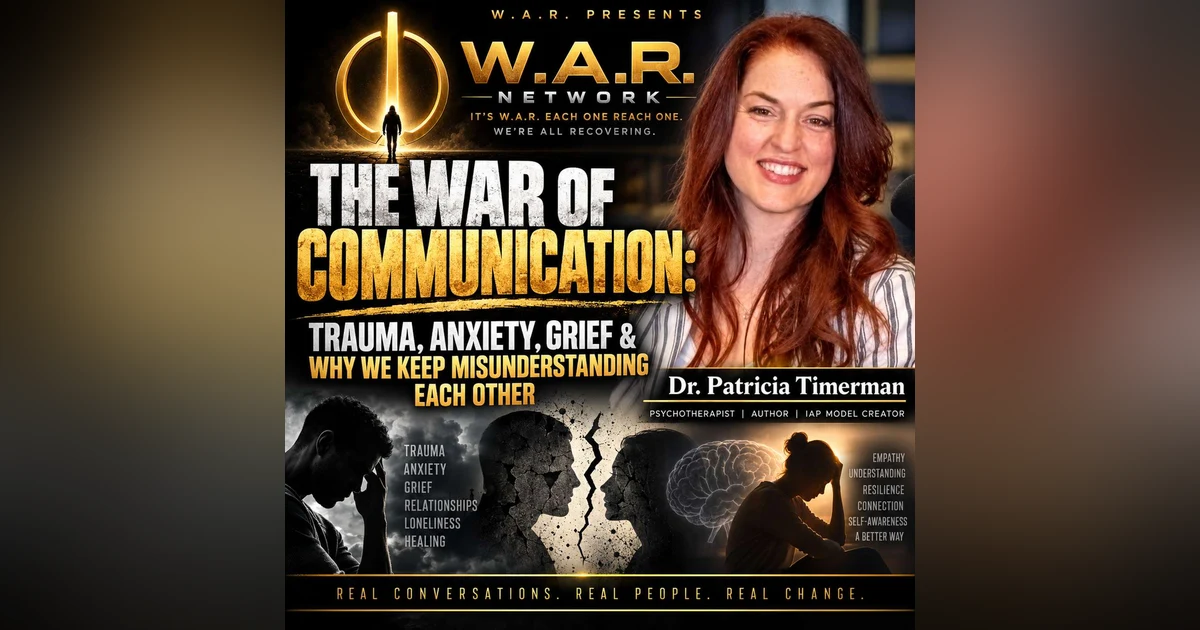
Join W.A.R. Founding Members THE WAR OF COMMUNICATION: TRAUMA, ANXIETY, GRIEF & WHY WE KEEP MISUNDERSTANDING EACH OTHER | Dr. Patricia Timerman | W.A.R. Network Why do people who love each other end up hurting each other? Why do conversations turn into arguments? And how much of what we hear is shaped by trauma, fear, and wounds we haven’t healed? In this powerful episode of W.A.R. Network, Stryker sits down with psychotherapist, author, and creator of the IAP Model (Intention, Action, ...
THE WAR OF COMMUNICATION: TRAUMA, ANXIETY, GRIEF & WHY WE KEEP MISUNDERSTANDING EACH OTHER | Dr. Patricia Timerman | W.A.R. Network
Why do people who love each other end up hurting each other? Why do conversations turn into arguments? And how much of what we hear is shaped by trauma, fear, and wounds we haven’t healed?
In this powerful episode of W.A.R. Network, Stryker sits down with psychotherapist, author, and creator of the IAP Model (Intention, Action, Perception), Dr. Patricia Timerman, for an unfiltered conversation about the psychology of communication, emotional pain, relationships, and recovery.
We explore why two people can experience the same conversation completely differently, how childhood trauma influences adult relationships, and why the intentions behind our words don’t always match their emotional impact.
IN THIS EPISODE, WE DISCUSS:
The IAP Model: Intention, Action, and Perception.
Why communication breaks down in relationships.
How childhood trauma shapes adult behavior.
Why men often struggle to express emotional pain.
Anxiety, overthinking, and emotional exhaustion.
How trauma affects the nervous system.
Suicide grief, survivor guilt, and unanswered questions.
Why people crave love but fear emotional vulnerability.
Immigration, displacement, and psychological resilience.
Modern loneliness and emotional disconnection.
What genuine healing looks like beyond social media.
Dr. Timerman also shares insights from her book, Why Are We Fighting?: Actionable Strategies for Effective Communication, examining how greater self-awareness and understanding can help us navigate difficult conversations.
This isn’t just a conversation about learning how to communicate better.
It’s about understanding what happens beneath the words, recognizing the pain we bring into our relationships, and discovering how to stop turning communication into combat.
If you’ve ever felt misunderstood, struggled to express what you’re feeling, experienced trauma, or wondered why the people closest to you sometimes hurt you the most, this conversation is for you.
Welcome home.
Subscribe to W.A.R. Network for conversations about trauma, mental health, recovery, relationships, and the human experience.
🌐 Website: https://www.warnetwork.tv
It’s W.A.R. Each One Reach One. We’re All Recovering!
⸻
HASHTAGS
#WARNetwork #DrPatriciaTimerman #MentalHealth #TraumaRecovery #Communication
Welcome, welcome home, everybody. This War, we're all recovering. Today's gonna be a real conversation as usual. No fake therapy talk over here, no social media motivational fluffs. We're talking about communication, trauma, anxiety, relationships, grief. But while people who love each other still end up emotionally destroying each other sometimes. You know, I'm joined by a psychotherapist, author and creator of the IAP model, intention, action, and perception. Dr. Patricia Timmerman, Doctor, welcome to War. We're honored to have you. How are you?
SPEAKER_03I am doing well. Thank you so much for having me over. I'm excited for our conversation.
SPEAKER_02Yes, ma'am. I'ma just get right into it. Uh, you know what's crazy? You know, two people can be in the exact same conversation. I was just thinking about this. And leave with completely different emotional experiences. Absolutely. One person thinks I was trying to help. Oh, that's me. The other person hears, you think I'm stupid. And that's why your IAP model hit me hard because most people don't realize communication gets filtered through trauma, insecurity, fear, ego, abandonment. I could go on and on.
SPEAKER_03Yeah, it's what is the filter that we are using when we go into a communication?
SPEAKER_02Right, right.
SPEAKER_03I remember, I mean, something as silly. So we talk about communication, like you and I, we are seeing each other, so we see each other's mannerisms. I don't have to be as mindful of my voice when I'm talking to you because you can see me as you hear me. When I worked at the 1800 Suicide, I had to be more mindful of my voice and my pace when I'm speaking with people. When we are a message, we lose tone. We lose right. And so I remember when I would message my supervisees just saying, like, oh, thank you for something, or they're running late, I'm like, that's okay. And they would receive us, thank you. That's okay. And I realized when they told me, like, I sound very intimidating. Right, right. But I it was being it was being perceived or received in that manner. So I became the queen of emojis as I learned because you know, with awareness comes action. And when you learn, exactly, you start to adjust.
SPEAKER_02Exactly. I I had that problem too, you know. I'll text message my brother something simple, and he'll be like, What's your problem? I'm like, I'm good. I'm you know, I'm happy, I'm good. I'm just, you know, like, what do you want me to do? So I start putting the emojis in there too, just just to, you know, break through that whatever it is. Speaking of breaking, can you break down the IEP model for people? Yeah.
SPEAKER_03Yes. So I started realizing that in communication, there's a relationship between our intentions, our perceptions, and then the actions that are used, right? So our perceptions are internal to us, our intentions. Only I know what my intention is of whatever I'm going to say. Attached to my intentions are the expectations of how it's going to be received and what the response is going to be. Perception is also internal, but it's internal to the receiver. And our perceptions are based on our own experiences of things and may be similar or may be different from the person that's speaking to us. The only external thing is the action itself, and actions can be verbals, non-verbals. I really get frustrated with the expression actions speak louder than words, because the implication is that your actions are clear to the people receiving it, right? Wow. It becomes the actions speak louder than words, is let's say that you're telling me something, but you're doing something different. Then I can say like your actions are speaking louder than your words because you're not congruent.
SPEAKER_02Right, right, right.
SPEAKER_03But just relying that my actions alone are going to tell you what I wanted to say without me knowing what is it that you actually want to say. You're just me leaving it open to interpretation.
SPEAKER_02Right. Right. You know what? And I say that a lot too to people, like, so I'ma think twice before I say it, but it's to me, it's just like a figure of speech, you know. So I just say your actions speak louder than words, you know, but not putting any thought into it, you know? And honestly, I think most people judge themselves by intention, you know, but judge others by impact.
SPEAKER_03Because we so there's this thing about I'm reacting to what you're giving me, and the other person can say the same. I'm reacting to you're giving me. So what you can see oftentimes in communication is, well, you hurt me when you did this. Well, you had hurt me when you did this, and my I did this in response to what you did. Well, I did this in response to what you did. And my question is, when did it start?
unknownRight.
SPEAKER_03Like we don't even know the action that started. We're just ricocheting of each other. So we are all hurt and no one is being heard.
SPEAKER_02Yes, yes, that's a great point. Like somebody says, always say, that's not what I meant, you know, but the damage still landed emotionally. So you know.
SPEAKER_03And I think there's something I it's not that I love apologizing because I do not, and I don't think people love apologizing at all, but I can very much be apologetic of the behavior that caused hurt, even though it was not intended in that way. My tone, I am a very direct person. And so sometimes my directedness can be received in kind of abrupt. Or if I'm in a rush, my tone is it's not like this nice and cute tone when I'm in a rush, that urgency, because my anxiety distorts time for me and it makes me feel like very urgent. So my tone comes out kind of cold, even though it's not my intention is not to be cold, but when I'm talking to you in that rushed space, my tone is not the nicest.
SPEAKER_02Right, right.
SPEAKER_03So I can be apologetic of I'm sorry that my tone hurt you. I'm not apologizing for the content or the intention, but behavior that actually caused offense.
SPEAKER_02Right.
SPEAKER_03I think people have a hard time with understanding that.
SPEAKER_02So do you think most people are reaching, reacting to what's happening or what something reminds them of?
SPEAKER_03I think a little bit of both. Um, sometimes when we let things accumulate, the smallest thing that seems like nothing will create that popcorn effect, right? Once that popcorn pops, it doesn't go back in.
SPEAKER_02Right.
SPEAKER_03So when we just like let things slide and let things slide and let things slide, at one point we can't angle. But I truly hold to the tenant that I cannot know what I don't know. You cannot know what you don't know. So although your response may be proportionate to you, it is disproportionate to me.
SPEAKER_02Right. Right, right. I truly don't think people are really fighting about dishes or text messages most of the time, you know. I think underneath it is you don't respect me, you don't hear me, I don't feel safe with you emotionally. You know, I'm just speaking from experience.
SPEAKER_03Now, I love the examples that you gave. You don't respect me, you don't hear me, I don't feel safe with you. And the distinction of using you versus I, right? The concept of the I statement, which people get get erroneous so often and it frustrates me so much. The I statement, the formula is I feel the emotion when something specific happens, what I would need and or want next time is. The easiest way to cheat the I statement is using the words like or that. I feel like you don't listen to me. I feel that you don't do enough. When I am accusing you of your action, as opposed to letting you know how that action impacted me, we become defensive. If I instead say I don't feel heard, I felt heard, hurt by this action, right? And try to evade the word you, it helps with not me talking about your action, but the way that the action impacted me, which then may give you the floor to understand, like, well, that was not my intention at all. Next time, what can we do differently? So my intention can land.
SPEAKER_02Yes. When you were speaking just now, just remind me, reminded me of a course that I vaguely remember because it was some time ago. Have you ever heard of Pears Communication? Yes. I'ma look, I'm gonna try to look into it. I wish you uh started speaking in like in my dream or something, so I could have that question for you. Because it's something that it's a course that I took probably like a year ago, and it was just breaking down everything that you just said, but it went so far, like really, really deep into it, and it made a lot of sense to me at the time. I don't know why I can't remember it. I'm gonna try to Google it later. Uh yeah, pairs communication. Do you think most relationship conflict is actually fear disguised as anger?
SPEAKER_03I mean, it can be fear, hurt. When you think of like triggers, right? Triggers are things in our life because we're a construct of our experiences. So things in our life that have caused some hurt or pain or anger in some way, shape, or form, right? And we then develop defense mechanisms to guard ourselves from that hurt or pain, or and anger is easier than pain. So we tend to hop into anger before we hop into hurt, right? Um, but the and our triggers can precede a relationship, right? So I have my baggage from my previous relationships before I entered my marriage, right? And so is my husband in relationship to his previous experiences before entering the marriage. And sometimes we are aware of those triggers, but sometimes we aren't until they kind of happen.
SPEAKER_02Right.
SPEAKER_03And there are things that in in the book I ask questions, by the way. This is my book, Why Are We Fighting? Actionable Strategies for Effective Communication. And so one of the questions that I ask is what are the behaviors or people or things that trigger you? Do they precede the current relationship? Because if they precede, then the response may be disproportionate to that specific individual and maybe giving them context to let them understand, versus is the trigger born from this relationship? Now, one thing to be mindful of is that a defense mechanism starts with a purpose. As I said, it is to guard us or protect us from hurt and pain. But when left unchecked, the defense mechanism just becomes automatic. Right? It just becomes part of life. That's how we just do things. And it's not until we start to question whether or not we still need it and kind of do like a system update that we can become better at utilizing it when needed and not letting it just come forward when it's not needed.
SPEAKER_02Hmm. I'm sitting here thinking when I become hurt, I wonder if everybody else feels the same. Like I'm usually scared. You know, but really or never ever say it, you know, that I'm scared. You know. So I'm wondering if hurt people, you know, ever come out and say, I'm scared. You know, or if it's a man thing, or you know, because you know, men have trouble being, you know, vulnerable and everything. So I'm wondering if it's just a man thing, or if it's just my thing, or if it's like uh everybody thing.
SPEAKER_03It's more common than you would think. I believe that it's hard to be vulnerable because vulnerability means connecting with somebody else and allowing them to be privy to something that I don't know how they're gonna receive. Right? But vulnerability can foster higher intimacy, can foster more understanding of each other, which can lead into growth. But because sometimes when we've been vulnerable, maybe in the past, we've been hurt, then what do we do? We just guard ourselves against everyone. But not everyone falls into the category of people that are gonna hurt you.
SPEAKER_00Right.
SPEAKER_03It just becomes difficult to distinguish who is worthy of my vulnerability and who isn't.
SPEAKER_02Yes, yes, yes, ma'am. You hit it on the nose. That's it right there. So I guess with me, nobody's worthy of my vulnerability. Absolutely nobody. You know, but and that's okay, you know, but you know, not even, you know, if since you put it that way, I'm thinking, you know, not even my wife. You know, she's the closest one to me, other than my kids. You know, but you know moving on. Let's get into childhood trauma, you know. I think adult, you know, exposes childhood wounds fast, you know, in adulthood. Some people grew up in chaos, some people, you know, feel so calm. It's like some people grew up abandoned, so silence feels feels threatening, you know, some grew up criticized, so accountability feels like I don't know, like an attack, right? Then people think this is just my personality. Again, I'm speaking for, you know, from experience. You know, when really is survival programming.
SPEAKER_00Yeah.
SPEAKER_02Right? How much of adulthood communication is actually wounded, you know, children trying to protect themselves.
SPEAKER_03I mean, we are a construct of our experiences, right? What I really love about the IEP and as I'm writing the book is it brings a lot of self-awareness. It talks a lot about like who I was, who I am, and who I want to become. So I have a worksheet. I put two bonus worksheets here. And one is the mean 3D, and that's who I was, who I am, and who I want to become, and how I see myself, how I believe others see me. I cannot know unless I ask. And how I would like to be seen. And as we're going through the IAP and understanding what are the things that trigger me? How is it that I communicate? How come I communicate in this way? I start to understand like what are the things about my childhood that continues to affect me in adulthood? What are some of the things that I want to maintain because they work for me? What are some of the things that I want to amplify? I want to do more of, and what are the things that I want to change? I call this the MEC acronym MAC, maintain, amplify, change. When we become more self-aware and understand where our defense mechanism and triggers and ability to be vulnerable or not be vulnerable and to speak up versus be quiet comes from, we become better able to choose when we do it and not just have that automatically done for us. Does that make sense?
SPEAKER_02Yeah, it makes perfect sense. You know, and you're you're giving me so much to think about right now, you know. Like, I, you know, my last psychotherapist, we did a lot of written exposure therapy and prolonged exposure therapy that just killed me inside, you know. But um the things that you're talking about, she she never spoke of. So I I I'm gonna research this deeply because it's really like speaking to me right now. Like I'm having therapy right now with this. I know it's speaking to a lot of people, it's gonna be speaking to a lot of people on this episode airs too. So thank you for that. And when I tell her my questions, you know, is because of things that that I'm going through that I feel, you know, other people are going through. Kind of like the question I'm about to ask you now, you know, like I think men are emotionally drowning right now, quietly. A lot of men weren't raised to communicate emotion, right? We were raised to suppress it. I know I was raised like all throughout my life, especially where I grew up at in New York City, uh was wild, and then going right into the military, you know, taught to suck it up and drive on. We wasn't supposed to communicate that stuff, you know. You know, outwork it, ignore it, drink through it, you know, stay busy through it. Numb it right, numb it. You know, then society asked, why can't men communicate? Yeah, right? Because nobody taught us emotional language. So instead of saying, what, I feel rejected, it comes out as anger for me, you know, I'm distant, I shut down, irritated, you know. Did do you think, you know, men are emotionally isolated more than people realize?
SPEAKER_03I mean, yeah, because like growing up, you're very right. And it depends on the culture that you're in, and being generation, being religious, racial, cultural, like national, wherever you are, patriarchal society, like they all can be different. But a lot of the times we are taught that women can have emotions and men cannot. And it's just the the stereotype of it. The same way that, like, if a woman is, you know, like crying, she's being hysteric. If a man is crying, it's like, oh, he's really going through something, you know what I mean? Like, so there's so many different ways of looking at the same thing. But I agree, and we talk about like the military. I remember when I was in the PhD and so and I had done research with respect to that, and we spoke with a couple different people, and they were saying, like, we can't like the weakest person there can mess up the unit. So, like, our emotions equal weakness, so we need to eat it up. When you talk about like if you're an active military and you're going through something and you like you get hurt physically, you do something immediately to numb that. It's the same thing with our emotions, since the reason we see so much substance use, right? When you leave the military, because you need to numb so many things that you've been privy to that the civilians have not been privy. And how do I go back to a regular life when like I have this entire movie of things that have happened that are in here? And now we talk about you know numbing emotions or learning to push them down. Now, emotions, they are part of our being, right? We you can think of our hormones, you can think like it is a physiological thing, the same way that when somebody tickles you, you laugh. It ain't funny. I don't like when people tickle me, but I left, right? When I am flooded with emotions, they need to come out somehow. There's this great book called The Body Keeps the Score, and it says like our psychology and our physiology, they are intertwined. Our mind and our brain, they are intertwined. So whatever we think or feel, it's like it's somewhere in our body. So I'm either gonna cry to release it, or it's gonna come out through vomiting, diarrhea, in between all of those, I prefer crying, right? If I live it in, then I have to daily push it in. It's a daily thing. Right? And because it is a daily thing that I'm pushing it in, I will then use maladaptive coping strategies to help me escape because living with it daily and having to push it in, it's unfathomable. Because it's again, it stays within our body. We can talk about anxiety and all of that. I actually, if I could, I wanted to read something from the book because I think it's gonna yes, ma'am.
SPEAKER_02Please do.
SPEAKER_03So, one of the things that I talk about in the IA key model is externalization of internal thoughts, right? And the reason for externalizing, think about breathing. For oxygen to come in, CO2 needs to come out. If you're holding your breath, oxygen cannot come in. CO2 is injurious to your body, and the longer you hold it, the worse it gets. Right? It's similar with our thoughts, our intrusive thoughts. When they stay in our heads and in our inside only, they don't have space to come out. When we use, when life gives you set stresses, use one of your five senses. When you externalize it simply by saying it out loud, without even using any other of your senses, but simply saying it out loud, you hear yourself. When you hear yourself, you're able to differentiate between what is fact, what is data, and what is bullshit, right? What is me creating stuff? But in here, it's really difficult. So I wanted to read do I have it in the right page? Let me see, because I have it, I think I have it on my virtual one. Yeah. Okay. So the significance of your Using our senses is the externalization of internal thoughts. It is important to know that our mood tends to grow in silence, resentment, anger, depression, anxiety, etc. The reason silence exacerbates our mood is because most thoughts sound true inside of our minds. And for some reason, whenever there's room for assumptions regarding the behaviors of others or sometimes even our own, the majority of the time we assume worst case scenario. Silence allows for assumptions to feel like facts, which in turn intensifies our feelings. Think of our sense as fact-checkers. By venting out loud or on paper, you become better able to distinguish between fact and assumption, between reality and exaggeration.
SPEAKER_02That's where that written exposure therapy and the prolonged exposure therapy come into play. Okay. I get it.
SPEAKER_03Yeah.
SPEAKER_02Okay.
SPEAKER_03The person who knows you the most is you. So oftentimes I'll tell my clients, talk to yourself in the mirror. I do. She knows me better than anyone else. Now she knows when she be asking and she knows when she's telling the truth. Say it out loud. I usually tell clients, like, do it in the shower because one, you can put music on, you can say it out loud, people are not listening to you. Two, you feel the water soothing you, right? You feel the water heating you. So it's a great way to have a physical, a tactile experience while also listening to yourself. Writing, there's the sense of touch. There's a you involve yourself more when you do different things or use your senses to externalize internal thoughts.
SPEAKER_02But you know, with the prolonged exposure therapy, you know, recording myself, then going back and listening to myself on my off time drove me nuts. I don't like if I I don't I didn't like listening to myself or or what it was, the written exposure therapy, not so much. I could handle that.
SPEAKER_00Yeah.
SPEAKER_02But just hearing my traumatic events replayed to me in my own voice over and over again drove me up the wall.
SPEAKER_03I can get that, and I think different things work for different people. There are things that in theory work and in practice will work for some and not work for everyone. I am a person that I will write, and one of the reasons that like when I say it, I don't record it. I either dictate it onto my phone because I don't necessarily like to listen to myself again.
SPEAKER_02Right, right.
SPEAKER_03When I write, oftentimes or the majority of the times, I will discard it or I just like rip it, which feels amazing. Um but if I'm not yet done with it, then I put it to the side because I may read it again. And it's not always that I do, it's just a matter of releasing and not necessarily revising. There are times when revision is important, which is understanding what do I want to get from this? How can I reframe it in a way that serves me? But revision is not always necessary. The release is what's most important.
SPEAKER_02I like the whole tearing up thing. I like that part.
SPEAKER_03I've had it with clients when I say, in a safe way, please, you can burn it. But there is something to be said about like ripping it, shredding it, erasing it, that is like I'm done with you. You're out of my system.
SPEAKER_02They should they should implement that. I like that. I like that. I'm gonna pass that along. I like that. Talking about anxiety, and you were speaking about it. Anxiety is brutal, isn't it? Like because people can look completely functional. Again, I'm talking about me. Completely functional, you know, externally, internally, you know, our minds is like on survival mode 24-7, right? Thinking, you know, preparing for a disaster that hasn't happened yet.
SPEAKER_03I'm gonna give you so I also struggle with anxiety. My anxiety comes in time distortion. Everything feels urgent. Um, and so my cognitive filter sometimes has become how urgent is this urgency? And when I tell myself how urgent is this urgency, it allows me to identify like, is there something, is there a consequence if I don't do this right here, right now? If there isn't a consequence if I don't do something right here, right now, then it's not urgent. It feels urgent, but it's not urgent. And that kind of helps a little bit. But yeah, our anxiety is the constant intrusive thoughts. When my intrusive thoughts come, sometimes I'm able to simply ask, what purpose do you serve me? Right? I woke up at I don't know, 3 p.m. is the time when like anxiety comes knocking our door, and I started like having these intrusive thoughts with somebody. I was like on a loop. I want to say I was awake for like 45 minutes and I'm just going at it until I stopped being a passive participant of my thoughts and became an active participant of my thoughts. And I asked myself, what purpose are you serving me? And then I answered. I'm like, it's serving my anxiety so much. She's hyped up, she's awesome. It's not serving me. I want to go to sleep and nothing is happening. This person is not here, they are not listening to the things that I'm telling them. Did you answer yourself out loud or my husband was sleeping beside me, so I was like having the conversation in my head. But is the difference between being passive versus active? A passive participant, my anxiety is driving the car, and I am just like not even beside her. I'm like behind and just like sleeping and listening to her. When I become an active participant, I'm sitting beside her and I'm like, I don't think you're going the right way. I think we need to redo this GPS. Uh no, no, stop, stop, park, park. I want to take over. Right? And I remember in this moment when I said, like, what purpose are you serving me? And I'm like, You're not serving me. I already know the message I want to say. This person isn't here to listen to it. I want to go to sleep and I can't. So what I started to do is I started to sing a song in my head that I knew the lyrics to. Can't start singing.
SPEAKER_02Okay, okay, okay.
SPEAKER_03Because you're gonna go insane. Because I wanted to put my intrusive thoughts to the background and focus on the song. And I think I went around twice before I fell asleep.
SPEAKER_02And then quiet down.
SPEAKER_03Quiet down because I didn't leave that vacuum open for my intrusive thoughts to take over. So becoming an active participant, meaning I'm gonna ask, what purpose are you serving me? Are these things true? Sometimes I will power pose, so it's opening up your chest, so your testosterone level goes up and your cortisol level goes down. So that's like confidence. There's a great TED talk by Dr. Amy Cuddy on it. And so I'll open my chest up and I'll do what I call factual affirmations. My anxiety is narrating all of these thoughts of things that are necessarily true. So factual affirmations are what is true? What is data that is unwavering?
unknownRight?
SPEAKER_03I'm really pissed at my friend because of blah, blah, blah, blah. I'm like, they did everything right. They asked me the questions. I gave them the answer. I wasn't happy with the result, but there was nothing that was done wrong or malicious. But in my mind, it's just going blah, blah, blah, blah, blah, blah, blah, blah, blah. And one of the things that neuroplasticity teaches us is that when our mind talks, our brain just is typing the novel. Like, tell me what is your narrative? You tell you tell me and I'll type it. It doesn't fact-check on its own. So when my intrusive thoughts are creating this narrative, I'm just going with it. And the more I go with it, the more animated I get. When I pause and I become an active participant, and I'm like, no, what purpose do you serve me? What do I know to be real? What is assumption? Now my brain is like, oh, okay, so let's type it this way. Does that mean?
SPEAKER_02Well, what if, like, what if your brain starts talking back to you? I'm just picturing, just driving myself crazy, just starting that conversation. What purpose do you serve me right now? And then I get an answer back or something, then we're just going back and forth. Because I have intrusive thoughts all day long. You know, like end up in a straitjacket.
SPEAKER_03Fair. Okay, so there's a difference between facts and assumptions. One of the, this is actually, I think, the first strategy I ever created for the IAP, which is the rule of three interpretations. So we have a fact, which is something that happened. Then we have our automatic assumption, like the first thing that comes to mind, which for some unforsaken reason tends to be worst-case scenario. I then ask you to identify two other possibilities. If you go worst case scenario for balance sake, I want you to think of a best case scenario. And then the third one is a likely case scenario, right? So this person, I don't know, they were supposed to call me, but they didn't. My let's say it's for a job interview. My immediate worst case scenario is, oh, I didn't get a job. I am such a loser. I can't believe I didn't get this job. I'm never gonna make it. And, you know, like all of that, one intrusive thought goes on top of the other. The only thing that we know is that we didn't receive a call. A second possibility is, oh, maybe they're between me and another person and they are having a discussion, hence the reason that they are taking so long. A likely is, oh, they're probably going through so much stuff that they haven't had the chance to call me yet. All three are valid.
SPEAKER_00Right.
SPEAKER_03My question then is which one serves you best? If you want to, like let's say you want to break up with your partner that didn't call you, and the first worst-case scenario is the one that serves you best because it gets you angry to break up, go for it. But if the second or the third serve you best, choose the one that serves you best. Don't let it be chosen by your anxiety. Does that make sense?
SPEAKER_02Yes. Yes, we need to study your book.
SPEAKER_03All of this is in your book, all of this, and I have worksheets for all of them because I'm a visual learner, so I like to create worksheets.
SPEAKER_02Right.
SPEAKER_03Yeah.
SPEAKER_02Okay, I'm gonna have all that in the description at the bottom where to get it, and yeah, because I need that book. Because the scary thing is with you know, anxiety can make your imagination feel real.
SPEAKER_03Yeah, 100%. Differentiating between fact and assumption is so important. It's so important.
SPEAKER_02Right. So, what do you think people are misunderstanding most about anxiety?
SPEAKER_03Anxiety is not stress. I think we all experienced stress. Anxiety, being anxiety or depression, when we're talking about a diagnosable mood, it impacts your functioning, right? It's not just something that you learn to deal with. So when I talk about depression, I usually say the way a way of describing it is imagine this invisible 500-pound blanket on top of you. And everything that you do from the moment you wake up takes so much effort. And then you start thinking, why can't everybody else do things so effortlessly? And I can't. Why am I less? Why? And all of those intrusive thoughts are added pounds, right? It's that the anxiety, one of the hallmarks of anxiety is anticipatory thoughts, and it's the anticipation of worst-case scenarios all the time. And it's so consuming that we have a really difficult time believing that what we think is gonna happen is not what's actually happening. And it takes so much energy, such an energy surge that sometimes you know how appliances, if there's an energy surge, they that's what happens with our anxiety when it gets so much we freeze and we try to continue to function while we are frozen, which worsens it even more. And then we start having negative intrusive thoughts about ourselves because you know, anxiety and depression are like best friends.
SPEAKER_02Yes, yes. It's the ones that you know, people, you know, when you say, Why is it happening to them, to me, and not them? The people, those people, the ones we call strong, you know, are sometimes the closest to burnout. We just don't know it.
SPEAKER_03We don't know because you said it earlier, like we seem like we're functioning, but no one sees what's in here, and we tend to water our neighbor's lawn as opposed to our own.
SPEAKER_02Right. Right. You just got my mind spinning right now, and I'll and I'm battling intrusive thoughts as well.
SPEAKER_00What's it?
SPEAKER_02No purpose, because it ha it really has nothing to do with me. I I'm thinking about the Knicks right now, and you know how they almost lost last night. And what's going on with them as a team if they had I'm just thinking of all kinds of craziness about them, and I fell asleep last night thinking about it. I think that's why I still on my line. But I'm a huge Knicks fan, so don't worry with me right now. Let's get back on topic. One thing uh people don't understand about trauma is trauma isn't you know just memory, it's physical too, right? So, like I was talking to my other guests a couple of episodes ago, then your nervous system completely changes, right? Your trust changes, reactions, safety changes. You know, can somebody logically know they're safe while their body still reacts like danger is present?
SPEAKER_03I mean, you know the first Matrix movie?
SPEAKER_02Yeah, yeah.
SPEAKER_03When you would go into the Matrix, if you died or got hurt in the Matrix, you died or got hurt in real life.
SPEAKER_02Right, right, right, right.
SPEAKER_03It's the same thing. Wherever our mind is, our body follows. So if my mind is saying danger, danger, my body is reacting, danger, danger, in spite of whether or not we are in danger.
SPEAKER_02Hmm. That makes me think of that sleep that people talk about, that dream, that nightmare, when you fall into the ground, but you always wake up before you hit the ground. Right? Have you ever heard that? I don't know if it's a myth or whatever, but if you actually hit the ground, you actually die in your sleep. Have you ever heard that? I have not. Yes, I've heard that before, but I wonder like, why do you always wake up before you hit the ground?
SPEAKER_03So I've heard different like ways that people talk about this. I wonder, I think it was a cousin of mine that said, This is like your soul leaves your body when you're dreaming, and then when it's coming back, it opens up its eyes and it sees you, and so it falls, and that's why you have to.
SPEAKER_02Oh wow, I never heard that one.
SPEAKER_03But there's so many different, and again, I go to you're the one that serves you best, right?
SPEAKER_00Right, right.
SPEAKER_03One of the things when we experience trauma, there's significance to sound, there's significance to think about our senses again. Smells. Have you ever heard of the 54321 copy shots?
SPEAKER_01Yes, yes.
SPEAKER_03Do you under do you know the reason for it?
SPEAKER_01No.
SPEAKER_03No. So the 54321, for anyone who has never heard of it, is thinking about your senses again. So five things you see, four things you hear, three things you smell are two things you can touch. Yeah. So actually, I end up doing five, four, three. Wait, I do five things you see, yeah, four things you touch, three things you hear, two you smell, and one that you taste. When you're going through an episode, we want to involve you back into reality. It's a grounding exercise. So if I am going to like a fashion flashback or a panic attack, and I'm with someone, and I'll say them, tell me what are five things that you see. Okay, I see the wall, I see the computer, I see the water bottle, I see the table, I see the chair. What are the four things that you touch? And how does it feel? I touch my skin, it feels soft. Touch the chair, it feels hard. The table, it feels hard. I touch my clothes. Okay, it's also soft. Nice. I touch the this this was four already. Three things that you smell. So as you're doing each of those senses, you're involving yourself into here, and so you're you're grounding your mind to the current environment. So the panic and the intrusive thoughts are going to the background. That's the reason for using the 54321 as a grounding strategy.
SPEAKER_02Oh, oh, oh, when you asked me that, I I knew it was a grounding, uh, I hear echo. Do you hear echo? When you asked me um if I knew what it was for, I knew it was for grounding. I thought it was like some you was gonna get like into some something else about it. I don't know, some deep medical terminology that I didn't know. But um, yeah, I have that, I have that on my um app actually. I have an app, and then I have a section where you go to that has grounding exercises and a 54321, you know, thing is on there for to kind of guide people.
SPEAKER_03Yeah. And so like when we think of trauma, right? There are sounds, there are any like tactile thing or something that I see or a word, there's a meaning or a history associated to it, and our body remembers it. Right. And when we don't process, when we go through trauma therapy and we're talking about it, we become very much aware and able to become at some point desensitized to it as opposed to being reactive and constantly on guard.
SPEAKER_02Right, right. And you've talked uh you you do it you've done extensive work around suicide grief. Yes. And I think that's a whole different kind of pain, you know, because people aren't only grieving loss, they're grieving unanswered questions and guilt.
SPEAKER_03Because I don't know what caused it. And as we are rational beings, we always want to understand things. We tend to either put a blame onto something or somebody, or bring the blame onto ourselves, and there's a lot of guilt if I and I call if I had only all the what ifs.
SPEAKER_02Yeah, what did I miss? And you know, and that guilt can can can destroy people.
SPEAKER_03Oh my god, absolutely.
SPEAKER_02And what have you learned about the emotional weight survivors carry after suicide loss?
SPEAKER_03I mean, again, I'll say like guilt and the lingering thoughts and questions, right? Going through every moment as if you were a puzzle. So, in my experience, I worked at the 100 suicide and then I facilitated survivor of suicide loss groups for about 10 years. And even being a survivor of suicide loss myself, it's incredulous. Like that first year, you're existing because you're like still in the days when things just happen, and at the same time, the year is going, and you have to, it's like two different worlds that you're living in. It's like we call it my survivor suicide group used to call it the suicide fog. You forget so many things, it's difficult to just function. The second year is a different kind of pain. It's that surviving is a reality that you hate, it's the reality that you don't want, but you're living in. And the third year is when you start seeing people kind of adjust to it. So the concept that it's within six months to a year is like, no, survivor, suicide, loss, grief. Usually what we see is at least three years for that july, for you to be able to adjust to that surrealism of the first year, painful reality of the second year, and the adjustment into a new life where my loved one no longer exists. And I still struggle with the things, but the intensity and frequency of the pain is what's shifting.
SPEAKER_02Healing is non-stop.
SPEAKER_03And that's when you seek assistance, because on your own, it can that time, you know, it can prolong because it's hard for us to manage all the intrusive thoughts.
SPEAKER_02Yeah. Let's let's let's let's try to brighten it up a little bit with that four-letter word, well, just a little love, right? Again, again, yes, yes, like I think trauma creates this contradiction where people desperately want to love but also fear it. You know? Like we crave connection, but truly we can't fully trust safety. I'm trying to find the words, and sometimes healthy love feels uncomfortable because chaos became familiar. Right?
SPEAKER_03I think it's important to identify like what does love represent to me? How do I want to be loved and how do I want to Love, because those are different things. Vulnerability can be part of love. Being understanding of others as well as being hurt, you know, can be part of love. Even grief is love. You wouldn't grieve, you wouldn't hurt if you didn't love.
SPEAKER_02Yes. Such a good such a good point. Do you think trauma survivors sometimes we sabotage relationships because, you know, before the relationship can hurt?
SPEAKER_03Oh, absolutely. I mean, I've said myself, yeah. Is the quit before I get fired experience. And so, in that, as you kind of again, I invite you to go through the book because in that self-awareness and understanding how come I do this, what purpose does it serve me? Do I want to find out what it is, or do I not yet feel ready? What do I need to feel ready? Right? Which then helps me understand what I can see from other people that make them worthy of my love and my vulnerability. And knowing that people make mistakes and understanding that a person is not their mistake, you know, can be very helpful.
SPEAKER_02Yeah, yeah. Talk to us a little bit about the work you've done extensively with immigration evaluations.
SPEAKER_03So I used when I was doing my master's in mental health, I was also working on an immigration law firm. So it made me very creepy to the Violence Against Women Act, U visas, asylum, trafficking visas. And because of my background in mental health, I kind of bridge the gap, right? So I composed clinical evaluation for immigration purposes. I do trainings for people to understand the role of psychotherapy in the world of immigration. Being either when we're treating somebody, because being an immigrant adds to, especially in where we are today in our society, there is such a fear surrounding it, and it can be so silencing. So, you know, being able to break barriers and helping our clients or you know, community feel like they have a voice.
SPEAKER_02What has that what has that work taught you about uh resilience?
SPEAKER_03Oh my God. I think all that I do teaches me about resilience with all of my clients. Like we can adjust to so much. I mean, just think about COVID. We can adjust to so much. So I I my work humbles me. And I love what I do because of that. But I really I appreciate so much you having me on. I really love our conversation.
SPEAKER_02Uh thank thank you so much for being here. Um this this has been very, very, very like enlightening to me. I can't wait to uh get your book and everything, and I'm gonna push that out there, yes, while we are fighting. Everything that you speak of, you know, the worksheets. You know, I have actually I have a big book of six-month material that I go back to look at because I was in a PTSD treatment program, and it has a lot, it has that pair's communication in it. Yeah. But when you get a chance, look that up. It might be some type of yeah, new communication format that they was coming out with or something, but pretty insightful. Doctor, doctor, this was powerful. You know, I appreciate you coming on. It was an honor. You know, and everybody make sure you check out Dr. Patricia Timmerman's book, please. Why are we fighting actionable strategies for effective communication? You know, I'll have all her links down in the description. Do you do, by the way, do you do like any kind of like online?
SPEAKER_03So I do individual therapy. I'm licensed in Florida, so and I'm doing direct therapy. I do it in anywhere in Florida, so I do virtually and I also do it in person. Um, but I also do consulting, training, speaking engagements, and that is nationwide, actually, anywhere.
SPEAKER_02Okay, okay. So tell the people where they can find you.
SPEAKER_03If you just go to uh my website, www.advocate2create.com, and the two is the number two. So advocate to create the number two.com. Um you can also find me on Instagram as uh Dr. Timmerman as well as advocate to create or Facebook and LinkedIn.
SPEAKER_02Yes, ma'am. Thank you so much again for coming on. It's been an honor. Everybody, thanks for watching. Till next time, each one reach one is Wall. We're all recovering. Peace.