The Closure Lie: Neal Tricarico on Grief, Purpose, Autism & Post-Traumatic Growth
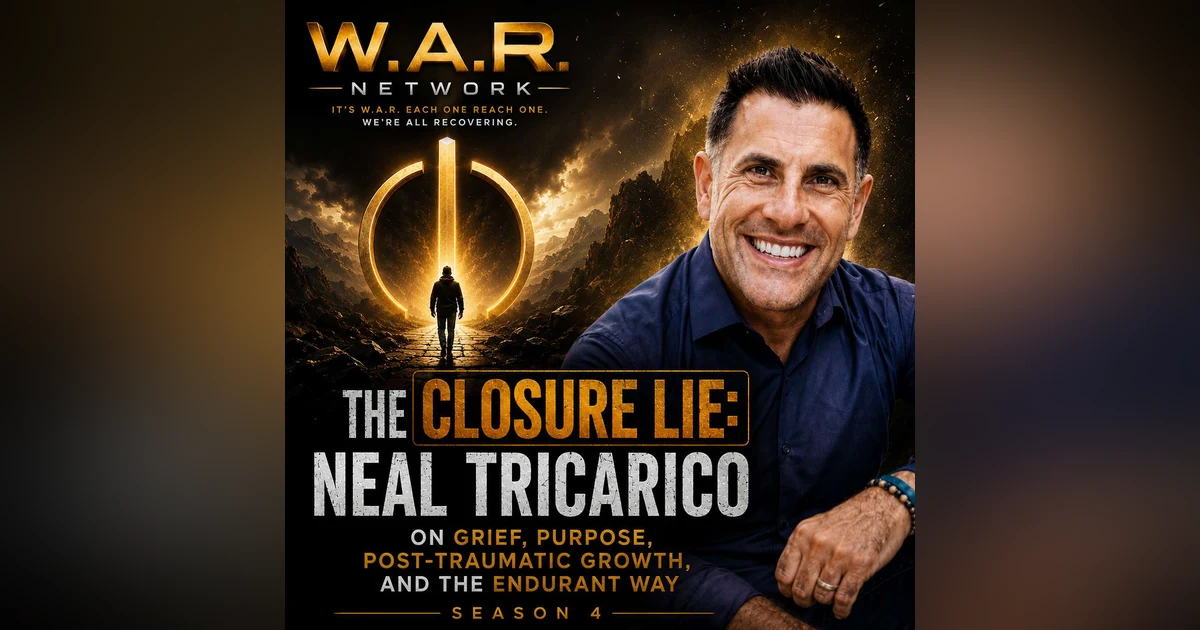
Join W.A.R. Founding Members What if closure is the biggest lie we've ever been told? In this unforgettable conversation, Neal Tricarico shares the heartbreaking loss of his son Anthony and the life-changing lessons that followed. We explore grief, post-traumatic growth, fatherhood, autism, purpose, and why healing isn't about "moving on"—it's about learning to carry love and loss forward. This is an honest discussion about resilience, identity, mental health, and finding meaning after unim...
What if closure is the biggest lie we've ever been told?
In this unforgettable conversation, Neal Tricarico shares the heartbreaking loss of his son Anthony and the life-changing lessons that followed. We explore grief, post-traumatic growth, fatherhood, autism, purpose, and why healing isn't about "moving on"—it's about learning to carry love and loss forward.
This is an honest discussion about resilience, identity, mental health, and finding meaning after unimaginable tragedy. Whether you've experienced loss yourself or want to better understand someone who has, this episode will stay with you long after it ends.
Welcome home.
#Grief #MentalHealth #AutismAwareness #WARNetwork #PostTraumaticGrowth
I mean, that's a great question. So, uh, you know, Tony Robbins talks about it a lot, the the science of achievement versus the art of fulfillment. And, you know, achievement is is important. They're not, you know, achievement and fulfillment aren't poles. They can coexist together. But yeah, I would say the the work with Tony Robbins had more of a breaking through achieving kind of approach intervention, but I I want to be very clear always, you know, from Tony was in service of fulfillment. All right. So uh achievement without fulfillment is the ultimate failure. That's one of my favorite Tony quotes. The the work with with Deepak and and specifically David G more recently is is really around the the spiritual aspect. And um that you know that wasn't focused really at all on achieving.
SPEAKER_02Welcome home, welcome back to war. We're all recovering. My guest today, Neil Chikarico. For more than 20 years, Neil worked in the personal development world, helping people pursue transformation, leadership, growth, and meaningful change. Then his own life changed forever. When he and his wife Samara lost their son Anthony to suicide. Neil's work today is not about pretending pain disappears. It is about what he calls the enduring way, learning to carry what happened while rebuilding identity, connection, courage, meaning, and purpose. We are going to talk about his work before tragedy, the beliefs that were tested afterward, the lie of closure, men in grief, spirituality, post-traumatic growth, and what it means to stop waiting for permission to live again. Neil, welcome to War Brother. It is a pleasure to have you.
SPEAKER_03I'm grateful to be here, James. Thanks for having me. And uh what a juicy set of topics. I'm grateful to hopefully add some value together with you to your audience.
SPEAKER_02Yes, sir. I know you will. And uh right before we start, Neil, uh, my son middle name is Anthony. And uh Yeah, and so this is gonna be powerful, folks. My son is autistic as well. Let's just let's just get into it.
SPEAKER_03That's great. Thanks for sharing that. I I see a lot of these synchronicities in my life. And what's what's your son's first name? I understand.
SPEAKER_02His first name is Jamin. His first name is Jamin. Very nice. My first name is James, so I put the N on the last, you know, I changed the S to an N because I always wanted a boy, and it was like Amen, you know. So I love it. I was like, hey, Jamin, you know?
SPEAKER_03I like that.
SPEAKER_02I like that.
SPEAKER_03That's really cool.
SPEAKER_02Thank you, thank you, sir. And I appreciate you being here again. Uh your story is deeply deeply personal to me. And, you know, like I said, my son is 14, he's autistic, and I I I our our experiences are not the same, and I would never pretend they are. But when I learned about your son Anthony, I did, you know, I did not process it only in a as a podcast host, you know. I processed it as a father of an autistic son. So I want to honor Anthony while also exploring the full body of your work and what you're building today.
SPEAKER_03Thank you. Thank you. That means a lot. It really does.
SPEAKER_02Yes, sir. Yes, sir.
SPEAKER_03And as you know, to know one kid with autism is to know one kid with autism, right? It's it's really there's some things that could be generalized or some very few, you know, patterns of similarity, but that's that's one thing that's interesting and and powerful about this diagnosis is is the uniqueness of each individual's experience.
SPEAKER_02Right, right, exactly. Okay, so before we discuss the event that changed your life, I want people to understand who was Neil Shicario before it all happened.
SPEAKER_03Great. I really appreciate that question. So, you know, I don't like to refer to myself in the third person, but to answer your question, you know, Neil Tricherico before uh all this happened, you know, was was someone who, as described by, you know, one of my dearest friends, is someone who loved to squeeze every ounce of joy, love, fun out of an experience, out of a moment. I'm a husband, a father. I cherish adventure with my wife, experiences with my children. When my children were younger, some of the most meaningful experiences were, you know, the the adventure guides through the YMCA and doing father-son, father-daughter camping, going snowboarding with my son, lovers' weekends with my wife, and you know, someone who, I guess, you know, for lack of a better word, had some some level of success in his career. Grateful to have landed and and befriended Tony Robbins and worked with him for parts of the last two decades. And as it turned out, that that experience ended up being training for me uh for what I didn't yet know was coming.
SPEAKER_02Right. And I uh I was just picturing everything the snowboarding and the lover's weekend. Man, you sound like a a terrific guy, and you know, you're living a a great life with your family, and you know, I I I appreciate that. Blessed life. Yes, yes, yes, yes, sir. And you spent more than 20 years immersed in in personal development and working around influential teachers like Tony Robbins, I've read uh D Pac Chopra and David G. I don't want to jack it. That I got it right, David G.
SPEAKER_03Okay.
SPEAKER_02Yeah, so what was your role during those years and and what did the world teach you about transformation? What did these guys teach you?
SPEAKER_03Yeah, man, really great question. So, you know, it was fascinating. Um, and not to take too much time on this, but uh so I came up in sales, high octane sales, late 90s, early 2000s, you know, Silicon Valley. And it it seemed that uh one of my gifts was influence and and specifically sales, but I was a very reluctant salesperson. I, you know, I didn't like coffees for closers, Gen Glary, Gen Ross, you know, Ring in the Gong. Even though I was number one on every sales team I was ever on, I was really reluctant. And my world opened up when my wife and I moved in 2004 from San Francisco to San Diego. And I did some work because I was really exploring a different career path. I wanted to find more purpose. And long, long story short, I met this amazing woman who helped me sort of navigate my gifts. And it turns out, you know, my core talents are influence and leadership, and that those are best applied to sales. But what we uncovered and set out on was that I would look for companies that I could work with and lead that were having influence and impact. And that's ultimately how I wound up at the Chopra Center, met David G and was able to build and lead a sales team for organizations that were having massive impact on people's lives. And and my work with David G and Deepak Chopra opened up the spiritual side of my life where I was able to bring in meditation. Um meditation, yeah, had a profound impact on calming my nerve nervous system, kind of, you know, really helping me sort of distance the the drama that was my life as opposed to being in it, having it at arm's length, having it come across my screen. And then through that experience, I was introduced to Tony Robbins. And in 2008, when the economy hit the skids, and um, you know, many entrepreneurs and CEOs were were struggling. He hadn't yet developed a business event or business program, but he wanted to do something for entrepreneurs and business owners to help them that summer. So I was lent out and was on this team to to have a business event called the Ultimate Business Mastery Summit. It was so successful that it it became ultimately what is now known as business mastery with Tony Robbins. And I I had a couple stints, two four-year stints on his executive team leading that that business, the business sales unit. And I'm grateful to be part of his chosen family and call him a friend. But the transformation was was real. I was learning aspects of understanding how to how to change my state, how to understand, you know, that life is happening for me, not to me. Also, even even on the side with Deepak Chopra, the the quantum physics side of things and spirituality, but it was fascinating because I really understood these things, but uh I was also blessed for the most of my life. I didn't I didn't have too much adversity until this event. Um, you know, I mean my parents separated for a couple years in high school. I lost my best friend to cancer in 34, but I I learned these things, and what I what I came to realize is like I understood personal growth. I understood transformation in an intellectual way, and I saw and co-participated in in clients and participants' transformational experiences, but these these skills that I were developing, you know, hadn't really yet been put to the test. So that's what I was sharing earlier. It it turns out all this time I was I was training for something that I didn't know yet what for, and and now now it's pretty clear.
SPEAKER_02Man, so you have like just all the work you've done, you have a great and important, like a strong foundation. And you could tell you're not unfamiliar with the with the growth, growth work, and you already spent years studying how people change, uh, how identity influences behavior and how you know human beings move beyond limitations. So, man, that's kudos to you, brother. That's cool. And um, you know what? You just said something. You you're in San Diego?
SPEAKER_03Yes, bro.
SPEAKER_02We could have done this in person. I'm in San Diego.
SPEAKER_03No way, yeah. We totally could. I'm in the studio. You could be sitting right next to me or something. I could be right next to you.
SPEAKER_02I'm in uh Chula Vista actually, in uh Otai Ranch area.
SPEAKER_03Oh yeah, okay, cool. Yeah, I mean I mean I'm in uh Cardiff by the Sea and Cenitas. We're okay, okay. We'll have you on my show and we'll meet in person. That'd be great.
SPEAKER_02Yes, yes, that would be awesome, man. Yes, great, great. So what originally drew you into that work?
SPEAKER_03Well, like I was sharing earlier, uh it was this sense of uh my my what appeared to me my God-given talents of of influence and leadership were being applied to sales, but I was so reluctant. Uh, I I didn't want to be known as a salesperson. That that was really a story that I had inside my head. But what drove me to personal growth was this this work that I did with this woman, Joanne Martin Braun, where I discovered, you know, quite simply and in common sense, right? Uh a dear mentor of mine shares with me when common sense becomes common practice, the extraordinary will happen. Well, it was like, hey, you have these gifts and talents. So instead of be reluctant, try and find a place where you can find some fulfillment. So personal growth really seemed to be a place where I could find that fulfillment. Helping others grow, break through, uh heal from their own traumas was massively fulfilling for me as opposed to selling some product or service or technology, which I had done before.
SPEAKER_02Was some part of you trying to understand yourself as well? You know, I I know you want to help other people and everything, but like, you know, were you trying to understand yourself and and you know?
SPEAKER_03Yeah, yeah. So yeah, that's such a good question, James. So I I don't recall that as part of it, just just being transparent, but what but that's precisely what happened, especially when I learned, you know, it's because part of being involved in the Chopper Center is, you know, you gotta eat the cooking. So I learned to meditate, I became certified in meditation. So I I don't I don't think I set out with that in mind, because in all fairness, it was about 20 years ago. So, you know, I was a lot younger and naive and you know, conquering the world kind of thing. So, but uh yeah, lo and behold, that's that's what happened.
SPEAKER_02Right, right.
SPEAKER_03I learned a lot about myself, right?
SPEAKER_02Exactly. Because I could see myself doing it, that's why I answered that question. And a lot of people enter personal development because they want to, you know, they want a person a better life.
SPEAKER_03Yeah, you know, so yeah, yeah. Well, that's an interesting piece because I I I feel again, we we we discussed, I feel like I had a really blessed life. You you know, when I when I looked around and and even you know, hearing myself tell the story and you feed it back about my life before, I I I I it it was like cherry on the top to to learn more about myself, to to be exposed to these methodologies that that we're talking about. It was it was awesome. And I also feel I don't like the word luck per se, but very fortunate, very, very lucky that that that's where I wound up because yeah, more than anything, I learned about myself and you know the the the the transformation right happened for me in magical ways and that that enabled me to help people in in so many ways because clearly in personal growth it it's authentic. I mean you you've got to live the work too if you're trying to help other people find their way to the work.
SPEAKER_02Exactly, right on. Exactly. Now, before Anthony died, how would you have defined resilience?
SPEAKER_03Yeah, great question. I mean, I think uh you know, I I I think it would have just been a lot simpler than I do now, more of like a stick-to-it-ness, uh uh never quitting and not giving up, uh, you know, resilient, it's powering through, you know, just a lot, a lot lighter kind of than I do now.
SPEAKER_02And and what about healing? How would you have defined that?
SPEAKER_03How would I have defined it for him?
SPEAKER_02No, healing, healing.
SPEAKER_03Oh, healing.
SPEAKER_02Yeah.
SPEAKER_03Well, you know, healing was for people that were going through really difficult life challenges that, you know, other than those two examples, I didn't have much experience with. I didn't have a lot of trauma. I mean, my parents separated, but they got back together. When I when I did lose my best friend at 34, that's when I was really kind of first experienced grief and and healing. Um but I saw so much healing in others because the work at both those organizations involved, you know, countless, numerous events where people came and I and I saw healing and transformation in them. And while I would never hope to have trauma to heal from, I felt so hopeful for these people, especially those who maybe have been carrying loss or pain or trauma for decades, right? I mean, that was what's most profound is to see people who are carrying or suffering for extended periods of time come and do the work and break through over the course of a week. And now their destiny could be shaped for the rest of their lives. They weren't being defined by their stories of loss.
SPEAKER_02Right, right. And I I'm asking because you know, those definitions can sound clear while life remains manageable, but then something happens that tests whether our beliefs can survive real devastation, you know. And like you say, decades, decades, and you know, those those people. I'm one of those people, by the way, you know, decades of uh of trauma, man. But that I'll save that for when I come on your show.
SPEAKER_03That sounds great. I'm definitely having you. You sit right here.
SPEAKER_02Yes, sir, definitely. Looking forward to it. So was the personal development world ever too focused on overcome or on overcoming, fixing, achieving, and producing results?
SPEAKER_03I mean, that's a great question. So you know, Tony Robbins talks about it a lot, the the science of achievement versus the art of fulfillment. And, you know, achievement is is important. They're not, you know, achievement and fulfillment aren't poles, they can coexist together. Um, but yeah, I would say the the work with Tony Robbins had more of a breaking through achieving kind of approach, intervention. But I I want to be very clear always, you know, from Tony was in service of fulfillment. All right. So uh achievement without fulfillment is the ultimate failure. That's one of my favorite Tony quotes. The the work with with Deepak and and specifically David G more recently is is really around the the spiritual aspect. And um that you know that wasn't focused really at all on achieving.
SPEAKER_02And di did it leave, did it sometimes leave to, you know, little room for pain that can't be solved?
SPEAKER_03Yeah, I mean, I would say so. I mean, you know, speaking for myself personally, actually, I haven't thought about this in some time, but I remember a year myself, my you know, my best year ever, um, I had made significant sums of money, uh a record amount of money. I think it was Christmas of well, yeah, it was right before COVID. So Christmas of 2019, and I remember wife and kids had gone to bed, and uh, you know, all the gifts were out. I was just sitting on the couch around the tree, and I was like, I just had this feeling like this is my best year ever, like my my family's not without. Look at all these gifts. Everyone seems happy and healthy, but I don't know, I was emotional. I burst into tears. I felt like, gosh, is is this is this really all there is? I just I felt like there would be a different kind of feeling. So yeah, I mean, just just speaking for myself, I think in in all this stuff it's it's not entirely black and white, right? We're aware, unaware, and it's uh it's uh an ebb and flow, if you will. That's my wife likes to remind me of.
SPEAKER_02Yeah, because I tell her these, I tell them my questions, uh Neil from my guests because I take a lot from you guys and I learn a lot from you guys, you know, and like I said, I'm still healing, I'm still a work in progress. So these are things that I think of on a daily basis, you know. My mind is always active and I'm thinking of these things. I'm like, hey, I'm gonna ask my guests this, you know, and so you're giving great answers, man, because the you know, whether I like the answers or not, you know, you'll never know. But uh I apply it to my life, you know? Yeah. Well, you could you could tell in my response for if the question if the answers resonate with me. But yeah, you know, the what you put there that that distinction matters because you know, there are problems we could solve and there are goals we can achieve, but you know, there are also realities we can't reverse regardless of our mindset, discipline, or our knowledge, you know. So that's right.
SPEAKER_03And and and there's and there's no there in all this. And I appreciate what you're saying because uh, you know, I've I've uh you know, I don't know, it's it could be a couple of years now, or it's coming on a couple of years. I went back to Tony Robbins' date with destiny, and you define your purpose statement. And my purpose statement is uh I'm a transmitter of love and wisdom, enjoying deep connection and life's moments, inspiring transformation in myself and others. And that's what that's what I that's what I say before I drop into my meditation each morning. But point being is inspire transformation in myself and others, because if we don't have it, we can't give it. So you know, parentheses, these things that we do with our podcasts and shows, parentheses, selfish because we'd be missing the whole point if we're not living the transformation ourselves, it would be inauthentic.
SPEAKER_02Yes, sir. You should you should be a guru, man. Yeah, just yeah, man. I'm I'm feeling it, everything you're saying. Absolutely right, man. Thank you.
SPEAKER_03I'm just like I said, blessed with all this experience. Uh just share it, sir. Gotta give it out.
SPEAKER_02Thank you for that. Thank you for sharing it with us. Let's meet Anthony. Yes. Before anyone hears about how Anthony passed away, I want them to know how he lived. Who was his son?
SPEAKER_03Yeah, yeah. So you know, I just watched something that that my wife uh did an interview that and she said, you know, Anthony lived every single moment of his life. You know, Anthony was a true blessing for my wife Samara and me. We had we had some difficulty conceiving, and so he was a true blessing and and gift from God. Our sunshine, love, love, our angel baby, sweet boy. And uh, you know, his childhood in many ways was was magical. Uh around six or seven, some things seemed to be off. We uh we looked to have him diagnosed, and he was he was diagnosed with high-functioning autism. And you know, that used to be called Asperger's, and it may even be called something else now. And and in in in some ways, that was hard for me because but it was important because I had to mourn the loss of my expectations of having a son. I envisioned it being it how it like was gonna be with my how it was with my dad, throwing the ball, playing team sports, coaching him, baseball, football, these kind of things. And you know, I I guess actually as we're sitting here speaking, that was the first experience of grief or loss of that that life that I expected, making it about me a little bit. But what it opened up for me was okay, it wasn't gonna be what I thought. I've got to set that aside. But then I came to understand the types of things that he was interested in that we could share together. And so uh I feel like our childhood with him was magical. We he loved to camp, he enjoyed surfing, he enjoyed fishing with his friends, he enjoyed surfing when he was little, then later snowboarding. But um, looking back on it, Anthony lived life like he knew his time was. Short. He maximized every moment, was constantly wanting to do more. And then also with the high functioning autism, his life was very black and white. And so he didn't want people to know of his diagnosis. He worked very hard to keep that from people, masking. And ultimately, as he got into his his teenage years, that that weight became unbearable. But, you know, and just in looking back at it, you know, it's it's it's been a couple of years now. So obviously I'm still carrying the pain. But what I find myself leaning on a lot lately is how grateful I am for almost, you know, nearly 17 years. And I'm also grateful that that I packed it in. For example, these YMCA campouts called the Adventure Guides, you know, father-son, father-daughter camping. By us here, they have eight camp outs a season. Well, the idea with eight is, you know, you you go to as few or as many as you want. But with his autism, it was like, well, there are eight, so we're supposed to go to eight. And so a lot of times, you know, maybe I was like, it's a lot, especially when I overlapped with my daughter, and I'd be camping sometimes two weekends back to back in a month. But whether I was coming back from a trip abroad for work or whatever it was, or leaving a camp out going on a trip abroad, I'm so glad that I said yes to every time he wanted to go because I could look back on those experiences with no regret. And of course, I wish there were many, many more years as I had hoped, dreamed, expected. I'm really grateful for those nearly 17 years that we packed it in.
SPEAKER_02Thank you for that. You you uh said something that uh deeply resonated with me and just hit my soul. Not only because you know, my son is autistic as well, he's a teenager, my wife and I was trying uh had trouble uh conceiving as well. You know, and when sh they was she was told that she couldn't, you know, uh conceive, and then when she did, it was like a blessing, and then it was like I call him, you know, my you know, my miracle baby too, my son, and and uh that's why I named him Jamin, because it has Amen in it. It was like Amen, you know, like this is all God's work, you know. Yeah. So answered prayer. Yes, and uh Man, brother, we are like Yes, yes, my son name middle name is Anthony, like this was meant to be, man. I'm you know, and yeah, and I you know, I understand why Anthony was trying to, you know, you know, he didn't want to disclose his diagnosis because a person should never be reduced to their diagnosis, you know, like it's the the world we live in, you know, like our autistic kiddos is just on another level. You know, they they see the world different and they see the world for exactly what it is, you know. And we just can't comprehend that, you know.
SPEAKER_03We can't, we can't, and uh you know, I may be getting ahead of where you want us to go here, but that that's ultimately what we we came to to realize. And and while there's really good work being done for our kiddos, it may not be the best work. The best work that I've come to find now, unfortunately, after the fact is the work being done around just what you've said. Um, you know, my son's diagnosis was ASD, autism spectrum disorder.
SPEAKER_01Right.
SPEAKER_03And I've come to meet someone who shared with us the amazing impact he's having on these kids just by removing the D. Just by removing the D. Because when we name something a disorder, when we label someone, especially with something as strong as disorder, now something's wrong with them. Yes. And and they need to be fixed. They need to have services to be normal. And we're not talking about you and I as adults, we're talking about precious young kids. And it hurts my heart to look back on how flippantly I just accepted that. But the best work that's being done is simply removing the D from disorder and helping these children understand that's their superpower. And it's it's only a it's it's a it's a characteristic. I have brown eyes, my Anthony had green eyes, like those are just differences. I'm neurotypical. Well, probably not. I'm certain I'm undiagnosed neurodiverse, I'm sure. But neuro, there's neurotypical and there's neurodiverse. And so when we help these kids understand that it's not a label or an identity or certainly not a disorder, but a difference, yes, like like skin color or eye color or hair color. Now, now they can feel a part of, and then all we need to do is help them find their tribe, right? Their their group where they fit in, they are belonging, they're they're superheroes, right? So, you know, ours might have been, or mine might have been, you know, Michael Jordan or Steve Kerr or Keith Hernandez or whatever. Well, theirs might be Elon Musk or whatever it be, but when we can help these kiddos find their superheroes and their tribe, that's gonna do more than any of the things that we're doing with these diagnoses, labels, and and right fixes.
SPEAKER_02Right. It's just like I said, we just don't understand them, and I think we should be trying to adapt to them instead of the other way around or them trying to, you know, adapt to us and you know, the the nonverbal autistic kiddos, you know, maybe they speak in ways that I have a whole theory about about this. They communicate in ways that uh, you know, we just don't know yet. Like we should be trying to learn that. And the the autism rate is going up, it's not going down. So maybe, you know, our DNA. I have a whole theory of this, Neil. I'm not gonna get into it. Let's get back to Anthony. Okay, but hold on.
SPEAKER_03Before we we maybe we'll save that for another podcast, but I just I want to say, brother, I'm tracking with you. So is Janen nonverbal?
SPEAKER_02Yes, he's nonverbal, right?
SPEAKER_03Yeah, I mean, he he speaks words, but you know, it's not in sentences. I mean, I I would like to have another convo on this because my my hallucination is our our beliefs are the same, and I've I've come to learn so much more, but it's yeah, there's a higher prevalence of the diagnosis. What's hard about autism, it's such a broad spectrum, right? Right. But um there clearly seems to be some spiritual aspect of it too, a correlation to a real gift level, and that these souls are here to help shed love and light. And I'm sure you're aware of the telepathy tapes, but the the magic that's what I wanted to get into. That's what I wanted, but I said I'm not gonna get into it, you know. I mean, yes, it it may be another podcast or another, because I I'm more curious about that for you because Anthony wasn't non-verbal. I mean, he he could pass, if you will. Many people didn't know, but I I I find it fascinating and I find it very believable and and true. So we we we should be nourishing and leaning into that because uh it's my hypothesis that these these kids, these souls are the ones who are bringing the life back in these most challenging times. Yes. And we could go there now if you want to, whatever you are. This is your show.
SPEAKER_02Yes, man. Yes, yes, I agree. We are here, we are eye to eye right now, Neil. We I'm telling you, we we thinking the same thing. But I want to I want to learn more about Anthony. What did what made him laugh? Because my son is hard, it is weird things that make my son laugh, right? Like, like, like it's just weird, right? Oh I I find weird.
SPEAKER_03So what what made Anthony laugh? What made Anthony laugh was a lot of of like silliness, just his younger nephew, you know, rolling around, wrestling, playing with his dog. But but it's interesting when we talk about humor. One of the things very early on as a child, especially in elementary school, is he wanted to be funny. Anthony wanted to be funny, he wanted to make others laugh. And uh one of his early teachers would share is like, Oh, Anthony is such a sweet boy. He went to uh a Montessori school, it was so beautiful, it really served him. And uh so she worked with him about comedic timing. So that was something that was always a little off for him. So um and I remember we heard from her like when he told this joke and it landed. So yeah, you know, I it's it's so so Ant, and we I call him Ant, by the way. That was his nickname. Okay. That I that I gave him, but it stuck to him so much. Speaking of elementary school, he went into the administrative office and told them to change his name. So from there forward he was known at Ant. So, anyways, long answer to your short question. I'm more hard pressed to think about things that made Anthony laugh than how hard he worked to bring others joy and make them laugh.
SPEAKER_02Right, right. Definitely, definitely an angel, man. And what was he passionate about? What could he do for hours without losing interest?
SPEAKER_03Others, others. He was passionate about his friends. You know, one of the things that they prepared us for in this work is uh, you know, in the in the work around autism, was that he may be sus have may have a hard time making friends or be susceptible to bullying. And he worked so hard at that. He poured himself into his friends, he had an abundance of friends, he was so blessed with friends, but that's what mattered to him most, especially in his teenage years, pouring himself into others. He just wanted to be with friends all the time.
SPEAKER_02That's great, man. That's great. I'm just getting to know him, you know. I appreciate that. Yes, yes. And uh what part of his uh personality reminded you most of your yourself? James hard one, huh?
SPEAKER_03Yeah, because we were so different, so different.
SPEAKER_02Take your time, man.
SPEAKER_03Take your time, so very different. But right in looking back and and also in real time, he like me wanted to help others. You know, he wanted to help others, and also I think our our sense of adventure and play were were very similar.
SPEAKER_01Right.
SPEAKER_03Part of what was hard was how different we were.
SPEAKER_01Right.
SPEAKER_03But it it didn't mean I mean there was so much love there. It just I struggled sometimes to I don't know about that. Like I was gonna say, I struggled sometimes to see myself in him. I don't I don't think that's true, but he it wasn't uh like a chip off the old block per se. Right, right. But but but at his core, I think our care, our heart, our heart, yes, our empathy for others is I think something that that we shared and and and I'm emotional about it because that's to me more meaningful in hindsight than if he liked baseball and I like baseball and I gotta coach his team. You know. But it it you know, it took some uh it took some uh some work that I was all in for and I would trade everything to have another shot.
SPEAKER_02Yes, yes. I could talk to you about something else right now and get into, you know, you're gonna see him again, you know, because I had my whole near-death experience and uh, you know, people I just won't get into it right now.
SPEAKER_03We'll talk about it later, but well, I just share with you I that we so we got a few conversations now. Autism, spiritual afterlife, but one of the true blessings of this entire experience was the love that our community poured into us. And if if you could believe it, you know, people want to give you gifts and and just help in any way, pray for how they can help you. So we had multiple mediums that gifts that were offered to us. So I know with certainty Anthony is is on the other side. I'm grateful for the the real communications that I've had with him through the mediums work that's opened up communications and connection that I'm able to have with him now. So while my old story was that my life will never be the same or as good as it could be because my son is no longer here, that's a BS story. My true story is well, I haven't gotten, you know, may not have gotten the life that I dreamed of. My destiny is still being written. And I believe we've contracted for this experience in some way to bring a greater level of awareness on this. I haven't shared it yet, but on this stat that unfortunately we became aware of weeks after Anthony's passing that kids with his diagnosis are nearly 30% more likely to take their own lives as he did. And yeah, exactly. I didn't, we didn't none of this was shared to us during our autism journey. I just an equate or someone I didn't even know found me on Facebook and said, Were you aware of this? There's this great work that's being done in the United Kingdom, and we were so unaware of it and so shocked by it. That was the calling to something greater, God, universe, spirit that said, We can't uh have another family experience what we've experienced, let alone another child take their life in this way. And that's when we founded the the nonprofit, the the endurant movement. So, all that to say, that's born out of the spiritual certainty that I now possess, James. I I I'm I don't want to assume, but I imagine that that you've felt that certainty. You may have had faith before, but the the NDE creating that certainty of this this truth that this is part of something much bigger.
SPEAKER_02Much bigger.
SPEAKER_03That's yeah, that's that's my lived experience, not not my belief or hope or faith.
SPEAKER_02Yes, sir. Well said, well said, sir. Thank you. What did it teach you about, you know, determination, discipline, you know, humor, love, or just seeing the world differently?
SPEAKER_03Great. So all all those, uh all three of those are important. So discipline and determination were his fuel. All right. So I think it was a blessing and to and a curse as part of this diagnosis is that black and white thinking. So discipline and determination were were core foundational values, principles, stakes of who he was. So that's why he was drawn to martial arts from a very early age, was a junior black belt, that that discipline, that determination, that strategy, those step-by-step processes. And then as he got into his teenage years, got into different types of martial arts, and then ultimately um Spartan races, like some Navy SEAL boot camp kind of things. He was the youngest kid to complete, yeah, one of these weekend things. And so, so discipline and determination were his oxygen. But I say blessing and curse because in those teenage years, and you know, again, that that 12 to 18 window is 16 and a half. Unfortunately, the more he strove for and the more he achieved, the less fulfilled he felt. And I just wasn't able to help him break through those things. As it relates to uh so what else is it? Humor. We talked a bit about humor, it was something that he really wanted to possess and create for himself, being funny. And then love in life was interesting. He loved so many others, and I felt I felt his love, you know, because autism is different with the the eye contact and yeah, you know, the difficulties expressing emotion, but the way he laid on me, leaned on me, touched me, like I felt that love, even though you know I the the the expression or the words weren't there, but in many ways, and looking back on it, that was more profound. Because sometimes we say I love you to people we care about just in a conditioned way. But uh, you know, my my concern was always uh to the extent to which you know he loved himself because he always put others first. I mean, this was the kid, you know, we'd be on vacation and be in New York City and go to a nice restaurant, and there'd be great leftovers that any one of us would have enjoyed late night or the next day or whatever, and every time we'd walk out, it'd there'd be a homeless person or whatever, and like his food, any of our leftovers, that's that's where they went.
SPEAKER_02He's truly a gift from God. Truly a gift from God. Truly. Oh man. As you know, and as Jay, I lost my train of thought. As as Jamin's father, you know, I've learned that autism is not one universal experience. You know, every autistic person has different strengths, communication needs, sensitivities, interests, and challenges, you know. And the the love part is right on right on the money. Like my son does the same thing. He doesn't say it, but he shows it. You know, he lays on me and you know, plays with my facial hairs and you know little things like that. So, you know, you definitely feel the love, and I've never loved anybody the way I love my son, you know. True that I do know. So I feel you, man. I feel you. What did you wish more, what did you wish more people understood about Anthony beyond the label autism?
SPEAKER_03Well, you know, what's what's fascinating is he masked all this so well that I feel like people that got to be blessed with the presence of Anthony in their life experience all that he truly was. I don't know to the extent matters isn't the right word, but you know, only his mother and I and his sister and you know, probably my parents and her mom knew his struggles. And I and I think, you know, hearing from so many of his friends now, like just just blown away, they had no idea that he struggled with depression. Many of them didn't even know he was diagnosed autistic. So, you know, may maybe on some level that they they knew that, but they were blessed to get to know all of him in his realness. They just didn't get to know how he hurt.
SPEAKER_02Right, right. Because you know, sometimes people hear like even I'm I'm I'm uh guilty of this as well. You hear an autistic young person is high functioning, so they need less support. You know, you think you think of people like Elon Musk and you know, you know, he's high functioning and he's uh you know, uh a trillionaire now. Yeah, you know, exactly just think, but uh outside of parents, you know, doesn't necessarily reveal what someone's carrying internally.
SPEAKER_03It's it's it's so it's so yeah. I mean we we share that experience.
SPEAKER_02Yeah. So uh how did being Anthony's father change you before grief ever entered the story? You have so many good questions.
SPEAKER_03So how did ant being Anthony's father father change me before grief ever entered the story? I would say it was this it was the experience that I shared towards the beginning of this beautiful conversation was when I first had to let go of my expectations of the son I thought I would raise, right? So I I just expected since I played team sports, football, baseball, and and and my dad coached me and we shared all that, that I would have this experience with my son too. And so I think the first thing it I was that that experience was really, really hard, but it was also a blessing because now I entered a world that I had no experience in raising an autistic child. And so I didn't I didn't have expectations, and so I just looked for opportunities to connect, finding things that we might enjoy together, and just just saying yes to I don't want to suggest I said yes to everything, but I sure said yes to all the adventure and experiences that he wanted to have, and that those experiences then inevitably opened up the things that he really enjoyed, like um rock climbing. We never would have learned about rock climbing without going on these camp outs or fishing or these things. So um yeah, it uh it it I guess looking back on it, you know, I had to had to grieve the loss of what I expected, but but much like I'm learning and sharing now, it's like in that opens up the possibility for what may be magnitudes more extraordinary. I mean, certainly I would have loved team sports and everything like that, but like when others were traveling and going from game to game to game, you know, we were either camping or or snowboarding or spending time together. Right. And that that proved to be a big blessing as opposed to watching him compete. I was engaged with him those weekends.
SPEAKER_02I'm so happy you got to share those moments with him. And I want to thank you, thank you so much from the bottom of my heart for sharing Ant with us and uh letting us get to know him. You and me both. Thank you. Thank you, thank you so much for that, and rest in peace, Anthony, and uh you will see him again. That that's a definite.
SPEAKER_03And I think that's an important piece. I know that with such certainty that that's what drives me more than anything. I I know the moment that Anthony and I reunite in heaven, it won't feel like a moment has passed. And when I know that to be true, why am I gonna waste whatever time I have remaining here? Not in the name of I've gotta live for everyone else, I gotta live for my daughter, I gotta live for my wife. Those things are are true, but more so because my work is not yet done and it's being driven through him from the other side of the veil now.
SPEAKER_02Yes, sir. Yes, sir. One I wanted I wanted to get into the uh closure lie, the c closure lie, excuse me. Yes. That's one of the most memorable ideas in your work. What exactly is the lie?
SPEAKER_03Yeah, so the the closure, the idea of closure is a lie. It it's a myth. Now, I don't want to take anything away from Kubler Ross's work and the five steps of grief. All all of those are true. I mean, those those experiences of you know of those of those five steps exist, but but grief, closure, this idea that okay, I've had this loss, I'm going to grieve it, I'm gonna go through these steps or some process, and then I'm either gonna be on the other side of it or I'm Gonna be who I was before is an absolute lie. And and so much so that I think I see you giving me the thumbs up. I think so much so that I think it's actually doing a disservice to people because the expectation is if I do this work, I will have this result. And so when they do the work and they don't have the results, most believe that something is wrong with them because this work existed, it must help in some way. And so why aren't they feeling different? So I want to take the idea and concept of grief as an experience with a start and end and set it aside. And what I've really found to be true is this concept of both end, the experiencing of duality of motions. It's it's my belief and my lived experience that we must stay just north of suffering. So, what do I mean? Like suffering is in the corner in the fetal position, completely incapacitated and unable to live, walk, breathe, survive. And you know, losing a child to suicide, no one would judge me if I suffered, if I just checked out. But that's not what we're here for. We're we're here because there's a purpose. We're here to give and grow. And so if we can find enough purpose, just something to place that love that has no place to go. And there are plenty of people and places to place that love. But if we could stay on just on this side of suffering into pain, now it can carry pain. In a in a silly example, if I had a painful headache right now, I wouldn't tell you I can't show up for this. I would play through with a headache. Well, this is a far more greater example. You can't see my heart. If I had broken my arm, you could see a cast. But my heart, it's not red, it's purple, it's bruised, it's beaten, it's been blown to bits, but bit by bit it's come back together. So, all that to say is the trauma has created a tremendous amount of pain. But instead of trying to work or go through some process to close and no longer feel that pain, I accept that pain and I hold it. Yeah. And that enables me to also experience the possibility. So extraordinary levels of pain, trauma on this end of the spectrum. But over here, now what's cracked open is extraordinary levels of joy, love, connection, intimacy. I appreciate life so much more than I ever did. I do believe I didn't take it for granted, but looking back, I sure did. Every moment that I'm able to connect with my wife or my daughter, silly trips that I go on with buddies, snowboarding or going to concerts, I appreciate them so much more. So my belief is this idea of some arc of closure is a lie, but that if we can carry both pain and connection, pain and joy at the same time, if we can transmute our pain into purpose, now what'll happen as we grow is instead of closure, that pain will still exist, but we'll get stronger at carrying it and it'll get lighter. Now I'm only two years in, but I could share with you that's been my lived experience. And I also have recovery as part of my story. And I feel like my two years or critical two years, that I could share this experience with others who are going through it, hopefully lift them up off the mat to create a pinhole of possibility that they too might be open to the possibility that there's still a life worth living. And if I can help them move out of suffering into possibility and let go of this lie of closure as an outcome, a result, now there's a possibility for this both. And if we can create the communities and safe places and love on folks like I was loved on, that they too might see what you and I are seeing in this experience that this is what life is really all about. Because another thing I've come to learn and realize is everybody has loss, everybody has trauma, everyone has experience. I I thought I understood that, but the things I've seen, heard, learned, my experience of losing my son in this way is every bit of parents worth nightmare. But I have dozens of stories that I promise you would strike you as far worse.
SPEAKER_02And this is why I do this, folks. You just gave me free therapy. This is everything you say, I can't. I'm shaking my head over here. Like I can't, I couldn't agree with the with you more. Like fantastic, fantastic. And cut and closure implies that something uh can be completed, sealed, placed behind us. You know, that's all good and dandy. It might work in a business transaction, but you know, it doesn't necessarily describe love or grief. So, man, you you're giving it to me. I I love it. I love everything you're saying, man.
SPEAKER_03I love it. It's it's your powerful questions that have opened up for this possibility to help each other and and your audience and and whatever this content is meant to to wind up.
SPEAKER_02Yes, yes, sir, yes, sir. I tell you, it's gonna wind up everywhere. I'm is uh I'm making this a free episode, so uh because everybody needs to get it. So thank you, thank you for that, thank you for that. That that hit me. And why can't chase chasing closure keep someone struck rather than helping them move forward?
SPEAKER_03Well, because there's the the the the finish line is never achievable. There's no there's no moment where that's done and you return to to where you were. And so it's it's it's like a false friend. I mean, you're it it it it doesn't happen. And and the reality of it is if you're living in this other way of the duality of emotions, you don't really want it to happen. I feel so much lighter than I did this time last year. You know, people told me the second year was the hardest, and I didn't want to take on that ex that story, but they they were right. But far and away, the second year was the hardest for whatever reason. But it it it it gets it's getting lighter now. And so again, the the pain still exists, but I'm stronger, so it feels different and lighter. But now I'm finding myself missing the pain, missing the the guttural moaning grief and crying and feeling like maybe I feel him less. And I I know that's not the truth. If integrated him in it to complete that, um it's it's it's not even it's it's pain and it's loss, but but really it's love. And so why why would we want to close out that love? You know, I'm speaking specifically of losing a child. That the you know, that that capacity to love is that a parent has for a child, that capacity is extraordinary. And so, yeah, it's really challenging. I have all this love that, you know, you hear has no place to go, but the capacity and that love still exists. So in the bottling up or trying to close it or or move it out or or go back to some place where you didn't have that capacity seems like a big mistake, in my opinion. But that love exists, and I can't pour it into my son anymore, but I can pour it into this experience I'm having with you. I can pour it into my belief that there are others out there suffering in the corner of the fetal position that that don't have the community and love and support that I have, and that I could place that love that I have for Anthony into multiple people in multiple places that could potentially impact and save their lives. So why why would I want to have some close or some end to the experience? It just doesn't pass the common sense test for me.
SPEAKER_02Right, right. So look before we close it out, let's get into your the heart of your current work. What is the endurant way?
SPEAKER_03Yeah, so the endurant way is a path to help adults who have made a decision that life is still available to them and worth living, but they don't know how to break through the struggles that they've been going through, the things that they've been doing to heal from loss or tragedy aren't working. And so, in long story short, the endurant way is that the methodology that I've created that I will take people through so that they can find their purpose. Because when your purpose becomes greater than your pain, you'll be compelled into action. And so, in a nutshell, that's the the the journey and if if the name, if you will, of sharing my lived experience so that others don't have to suffer from suffer-worthy experiences that that hopefully they too can unlock the calling to something greater and transform their lives. And that's it starts with community, it starts with transmission like we're doing here.
SPEAKER_01Right.
SPEAKER_03And then and then we can do do the work so that we can help people break through the myths of of closure, of survivorship, any of these things, and let go of what's not working for them and hold this space and love on them in community, but give them specific tools so that they can open their hearts, open their eyes, so that that gift from God, spirit, universe that exists can be felt and lived. And that moment of that purpose transcending their pain even in the smallest way will create a purposeful life for them. And this this has become my life's work. Going all the way back to the beginning of our call when I talked about I have these gifts and I don't feel like the career of sales is the most fulfilling place for them. Well, now I've found the most fulfilling place for them at a tremendous cost, uh, cost that I would trade it all back for, but knowing that that's not possible, I honor and am grateful that that I've truly found the confluence of my gifts and my purpose.
SPEAKER_02Right. And you've been clear that this isn't about pretending the pain is gone, it's about creating a way forward, you know, while at the same time acknowledging that you know your life is permanently changed. Yes. You know, so thank you again, sir. Thank you for everything you're doing. Thank you, James. Yes, yes, sir, definitely. And endurance, you know, feels active. It doesn't, you know, describe someone waiting passively passively for suffering to end. You know, you know, to me, it it describes someone learning how to carry what life is given. So I think endurance is the perfect, perfect word, man. You this is your calling, man.
SPEAKER_03This is your calling. James, hold on just a second. I think I'm gonna borrow that. And endurant is uh say endurant is uh helping people find the life worth living. It's so powerful to add that on because the textbook definition is capable of overcoming hardship or adversity, but I think we're gonna borrow what you've shared here. I want to get it right because endurant is active, it is possessing those capabilities. Now, and again, it's like all that we've talked about in this last hour, there is no there, there's no outcome, there's no result, it's it's something within us. So thank you for contributing so meaningfully and opening up this space where we could transmit and and hopefully if even if it's just one person finds their way, uh, this has been valuable. Well, it's been valuable time because you and I have learned and grown from it too, but I think it's gonna help others as well.
SPEAKER_02Right. Thank you, sir. And you know, Neil man, I wish we could go on for hours and hours, man, because this this is a great conversation. It is. But we're gonna close and I wanna, you know, ask you, you know, you and Samara helped create the endurant, you know, movement. What is its mission today?
SPEAKER_03Great question. So its mission today is that that we want to endurant exists to the endurant movement, the nonprofit exists to ensure that no child, no youth, no teen is left unseen. And the purpose is to help, you know, neurodivergent and neurotypical youth be seen and understand that their lives matter. And the effort is specifically around awareness is the cure. We want to find help other families with this diagnosis navigate these critical years with their teens so they don't have to become one of these stats of nearly a a third who end up, you know, losing their life in this way.
SPEAKER_02Right. And what do you hope Anthony's legacy changes for neurodivergent young people in their families?
SPEAKER_03I I it is our belief that Anthony's legacy is helping these families see and understand that their children are not their diagnosis, they're certainly not the label, and they're certainly not a disorder, but that they're a meaningful, viable, impactful, valuable place in our world, and they're deserving of love, connection, inclusion, um, like everyone else.
SPEAKER_02And my final question what would you tell someone who believes that continuing to live fully will betray the person they lost?
SPEAKER_03You know, that's a that's a great question. What I would tell them is, you know, that that's not my belief, and it's certainly not my lived experience. But I know it's really, really hard for you because there's so much suffering and so much pain that that would be the belief. But what I would invite as an alternate possibility to consider is what would then happen when you arrive and reunite with them and you found out that that was wrong, that you spent these months, these years, these decades with this belief that if I carry on, if I live not only my life to the fullest, but fuller than it was before, that you were wrong about that. And they had really hoped that that this experience was the opportunity to live even fuller, to appreciate life even more. So maybe playing with that possibility, because you know, that's your and I lived experience through, you know, through your near-death experience and and my connection with Anthony on the other side, we're blessed to know that with certainty. And we can't just push that on people, but to just play with the possibility that then what? Then you're gonna look back with regret yourself all these past years. So if if we really truly don't know or you don't believe, James and I, it just seems like it might be in greater service of your lost loved one to approach this way because I find it hard to believe that we're gonna arrive there and they're gonna say, Man, I can't believe you didn't show the world how affected you were by me not being here, and you just shut down. I mean, that just seems unlikely.
SPEAKER_02Right on, right on. And and living again doesn't mean that the love ended. Correct. It means, you know, the love is being carried into the life that remains. So, you know, right on, right on, you know. And I hope people will hear that. And Neil, I want to thank you for the from the bottom of my heart from everything, everything that you share with us, from you know, the work you're doing to sharing Anthony with us and uh getting us allowing us to know Anthony as a son, a young man, and a complete human being, rather than reducing him to the way, you know, his life tragically ended. And that means a lot to us. And uh thank you for showing us that your work is not only about grief, it's only I mean, it is about identity and devastation and growth.
SPEAKER_03So amen, brother. Thank you for having me on the show. This feels like just the beginning. I I know I mentioned I've I've got to jump into something, but let's let's stay connected. I'd like to continue the the conversation on my show, on your show. There's a lot more we can unpack together to help people. I'm honored and blessed to have met you and grateful to be on your podcast today. It means so much. Thank you. Thank you, thank you. I feel the same way.
SPEAKER_02And to learn more about Neil Chicarico, the endurant way and his free resources, visit Neil Tricaricari the Chicarico.com. Did I get it right?
SPEAKER_03Chicarico, right? Okay, neiltrecarico.com or the endurantway.com. I'm sure we'll have some stuff in the the show notes. But if you or anyone you know is struggling, is suffering, please reach out. There's there's resources and a way, and we're here to support and help you.
SPEAKER_02And listeners can also check out the enduring movement and his work involving autism, neurodivergence, mental health, suicide prevention, and post-traumatic growth at endurant movement.org.
SPEAKER_03That's right. That's the nonprofit, endurant movement.org. Thank you for that shout out there as well. We need all the support we can get saving these lives.
SPEAKER_02Thank you. Until next time, folks, each one reach one, it's war. We're all recovering